Amir Mahmud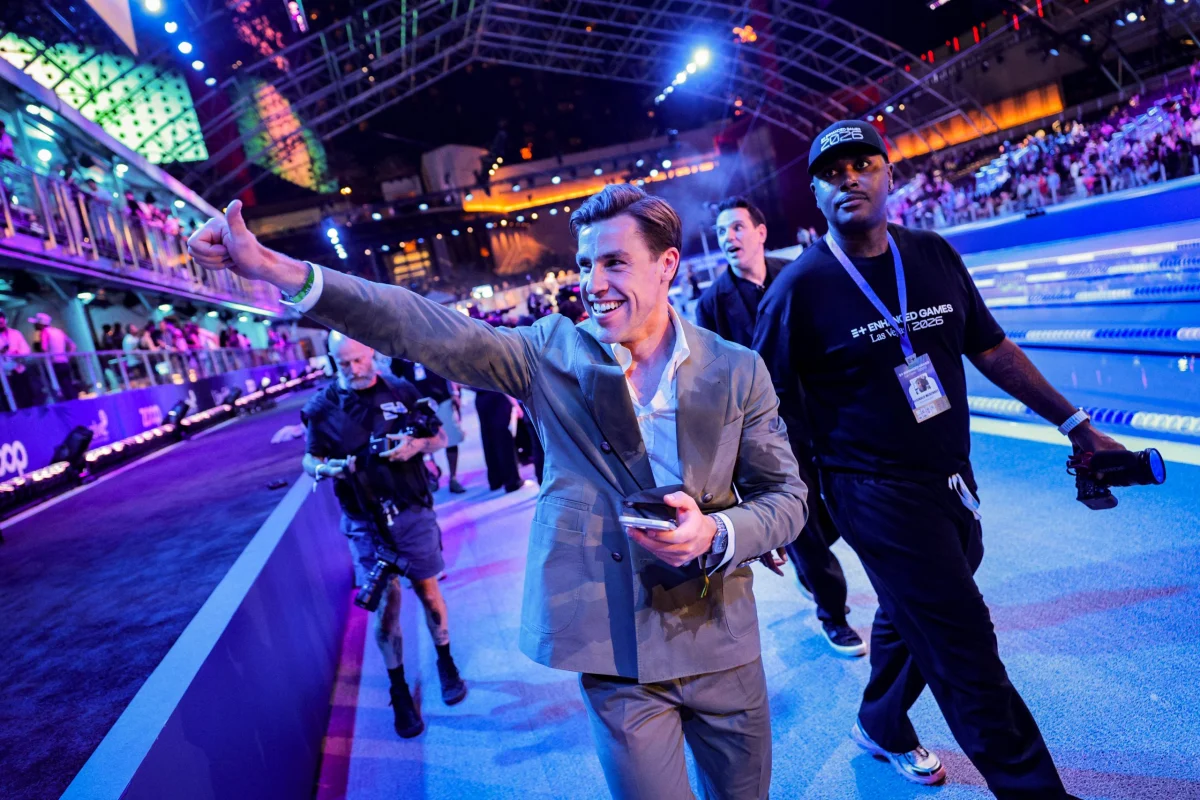
Under the scorching Nevada sun, a collective gasp rippled through the spectators as Boady Santavy, a Canadian Olympian with a physique sculpted like a comic book hero, strained against the immense weight of a barbell. His massive, almost cartoonish arms, seemingly more suited for a superhero than a human athlete, trembled as he attempted to hoist 183 kilograms, or approximately 403 pounds, in a bid to surpass the world record for the men’s snatch. After a few agonizing seconds, the bar crashed to the ground, signaling a "no lift." Santavy, visibly frustrated, hobbled away, a look of animated dismay etched across his face, muttering curses under his breath. This dramatic scene unfolded during the inaugural Enhanced Games in Las Vegas over Memorial Day weekend, an unprecedented athletic competition where the use of performance-enhancing drugs is not only permitted but actively embraced.
Santavy was one of 42 athletes—weightlifters, swimmers, and track runners—who converged on Las Vegas for this controversial event. Dubbed the "steroid Olympics" by its detractors, the Enhanced Games took the radical step of allowing participants to utilize a wide array of performance-enhancing substances, including anabolics, testosterone, peptides, and human growth hormones. This chemical augmentation was carried out under the careful guidance of medical professionals. Many competitors, a diverse group spanning various ages and skill levels, reportedly spent twelve weeks at an elite compound in the United Arab Emirates, where they trained and worked with doctors to customize their "protocols," or drug regimens, to their specific physiological needs. Beyond the opportunity to compete, athletes also received appearance fees, with substantial cash prizes—up to $1 million for events like the 100-meter sprint and 50-meter freestyle—awaiting those who broke world records or secured top finishes. The Enhanced Games, in essence, cast aside the established rulebook for professional athletic competition, sparking a global debate.
The Genesis of the Enhanced Games: A Silicon Valley Vision
The peculiar spectacle of the Enhanced Games, far from being a grassroots athletic movement, originated from the innovative—and often disruptive—world of Silicon Valley. This venture is the brainchild of a former startup founded by individuals with backgrounds in cryptocurrency, artificial intelligence, and biotech firms. It has garnered significant financial backing from influential figures like venture capitalist Peter Thiel and former Coinbase executive Balaji Srinivasan, signaling a deep entanglement with the tech industry’s fascination with human optimization. The event serves as a prominent showcase for a burgeoning industry that Silicon Valley has eagerly adopted: human enhancement, which promotes injectable drugs and ingestible supplements as avenues for both physical empowerment and lucrative business.
This approach has, predictably, drawn sharp condemnation from established athletic and health organizations. The World Anti-Doping Agency (WADA), the global regulatory body for the Olympics, publicly labeled the Enhanced Games as "dangerous and irresponsible." Similarly, Travis Tygart, CEO of the U.S. Anti-Doping Agency (USADA), dismissed the event as a "clown show that puts profit over people." Their concerns echo long-held apprehensions within the international health community regarding anabolic steroids and even some federally approved consumer drugs.
A Challenge to Traditional Sports Ethics
Organizers of the Enhanced Games, however, present their initiative not as a reckless endeavor but as a pragmatic solution to a deeply entrenched problem in organized sports: the pervasive, yet clandestine, use of performance-enhancing drugs. Their argument posits that by openly permitting and medically supervising drug use, they mitigate the inherent risks associated with secret doping, where athletes often resort to unregulated substances without professional oversight. In this "enhanced" model, transparency and medical guidance are touted as pathways to a safer, albeit chemically assisted, form of competition.
However, the Enhanced Games are more than just an athletic competition; they represent a significant commercial enterprise. The event is a flagship initiative of Enhanced Group, Inc., a newly public company that achieved a $1.2 billion valuation upon its IPO. Beyond the games, Enhanced Group operates a consumer platform, "Live Enhanced," which offers personalized health treatments including peptides, GLP-1s for weight loss, and testosterone injections—all marketed as physically "enhancing" drugs. The company has also forged a strategic partnership with AI firm Rezolve Ai to develop a digital telehealth platform, further integrating technology into its health and performance offerings. The broader ambition of Enhanced Group is to scale its Las Vegas model into a global business, creating a distribution network for consumers seeking physical augmentation and anti-aging solutions. While the drugs sold by Enhanced Group are FDA-cleared, critics worry that by normalizing steroid use through a high-profile athletic event, the company risks a "trickle-down effect" on wider culture, potentially leading younger consumers to seek out less regulated and more dangerous compounds with potentially disastrous health consequences. The athletic competition itself is thus viewed by many as a grand advertisement for Enhanced Group’s business interests and the broader peptide industry.
The Peptide Phenomenon: Silicon Valley’s New Frontier
The choice of Las Vegas as the venue for the Enhanced Games was no accident, aligning with the city’s reputation for spectacle and consumption. The event also highlighted Silicon Valley’s growing obsession with "human enhancement," particularly peptides. Peptides are short chains of amino acids, the building blocks of proteins, and play various roles in the body. While some peptides are FDA-approved for specific medical conditions, a vast array exists in a regulatory "gray zone," marketed for everything from muscle growth and fat loss to anti-aging and cognitive enhancement.
This fascination gained national prominence when U.S. Health Secretary Robert F. Kennedy Jr. expressed his admiration for peptides on "The Joe Rogan Experience" podcast, hinting at plans to encourage the FDA to broaden public access to certain peptides. Following this, the FDA announced a pharmaceutical advisory committee meeting to consider loosening restrictions on previously banned peptides. This regulatory landscape has spurred a "gold-rush-like" boom, with startups reportedly developing products based on chemicals in this legal ambiguity, aiming to be first-to-market if regulations ease.
Silicon Valley has emerged as a hotbed for this frenzy. Tech professionals are both users and investors in the peptide market. Companies like Superpower, an AI longevity startup offering FDA-approved peptides, and Noho Labs, a peptide startup backed by prominent investor Elad Gil, have risen to prominence. Elite social hubs like the AGI House have even begun hosting "peptide injecting parties," underscoring the widespread personal use among the valley’s affluent.
Beyond the Bay Area, peptide use is surging across the country, fueled by an aggressive upswing in fitness culture. Reports indicate that teenagers and young adults are increasingly turning to peptides for "looksmaxxing"—a trendy term for extreme self-beautification efforts—as the gym becomes a central hub of youth culture. Social media platforms amplify this drive for physical perfection, with influencers like "Clavicular," Joe Rogan, and Andrew Huberman promoting or discussing peptides, further embedding them into mainstream consciousness.
Performance, Profit, and the Pursuit of "Health"
Maximilian Martin, the 29-year-old CEO and co-founder of Enhanced, calmly defended his company’s practices during a press conference. Martin, a former bitcoin mining entrepreneur, projected an image of composure and affability, speaking soberly about the company’s plan to monetize the creation of a "new generation of chemically-altered mutants." He drew parallels to Hollywood, suggesting that the public already accepts enhancement in figures like Marvel superheroes, implying that the market for such transformations already exists, albeit largely unsupervised. "The peptide market in the U.S. today is already 85 million people. Most of that market is served by unsupervised, unregulated substances that people are taking," Martin explained. "What we’re doing is we’re entering that market with a pathway for people to get to those benefits that they’re looking for in a safe and medically supervised way." Christian Angermayer, Enhanced’s billionaire co-founder and executive chairman, was more direct, stating, "I’m a capitalist," and asserting that there is no inherent conflict between generating profits and promoting health.
The actual day of the games, May 24th, unfolded as a sweltering blur of events within a purpose-built, $50 million open-air stadium at Resorts World Las Vegas. The complex, erected in a matter of weeks, featured a track, swimming pools, and a weightlifting pavilion, all surrounded by enthusiastic spectators. While the setting superficially evoked the grandeur of the Olympics, the atmosphere felt more like a hybrid of "America’s Got Talent," WWE wrestling, and the cinematic drama of "Gladiator." Social media influencers populated the stands, and a booming announcer narrated the day’s proceedings, lending a professional wrestling ambiance. The evening concluded with a concert by The Killers, a staple of Las Vegas entertainment.
Athletes, with their hypertrophied muscles glistening, moved across the grounds like mythical figures. Martin, impeccably suited, traversed the venue, eventually becoming drenched as he rushed to embrace winning swimmers. Angermayer maintained a serene presence, engaging briefly with the press. Other notable tech figures, such as biohacker Bryan Johnson, were also present, with Johnson offering commentary on the spectacle.
The competitions themselves offered moments of genuine thrill. Among the diverse field of competitors were individuals like James Magnussen, a retired Australian Olympic medalist swimmer, who saw the games as an opportunity to return to elite competition. Magnussen, whose visibly enhanced physique had previously gone viral, had openly endorsed peptides and testosterone, claiming they made him feel "18 again." Despite his enthusiasm, he failed to break any records, finishing last in two races. Hafthor "Thor" Bjornsson, the massive Icelandic strongman and "Game of Thrones" actor, openly admitted to past steroid use and welcomed the opportunity for medically supervised enhancement. Bjornsson made a thrilling attempt at a 1,135.4-pound deadlift world record but ultimately fell short.
Interestingly, not all competitors embraced the "enhanced" philosophy. American swimmer Hunter Armstrong chose to abstain from all supplemental intake, driven by his Olympic aspirations and a personal aversion to doping. "The Olympic movement is something that is very important to me," Armstrong explained to journalists, emphasizing that engaging in such protocols would jeopardize his future opportunities. Remarkably, Armstrong was among several "unenchanted" athletes who still managed to win their respective races, including the 50-meter backstroke.
The day concluded with a dramatic flourish: the final event, the men’s 50-meter swimming freestyle, produced the games’ first and only world record. Kristian Gkolomeev, a towering Greek swimmer, surged across the pool in a blistering 20.81 seconds, eclipsing the previous record by a mere 0.07 seconds. The crowd erupted, venue lights flared red in a game-show-like celebration, and Martin, once again, rushed to embrace the dripping Gkolomeev.
The Future of Human Potential: Vanity or Advancement?
Critics maintain that the Enhanced Games prioritize profit over genuine health, a sentiment difficult to dismiss given the event’s lavish commercial underpinnings. Yet, an underlying current of vanity—both societal and institutional—also permeates the venture. American fitness culture has long extended beyond mere wellness, often veering into self-aggrandizement. The Enhanced Games, with its overt pageantry of physical perfection, aligns seamlessly with this cultural inclination. The choice of Las Vegas, "Sin City," a place synonymous with hedonism and fleeting indulgence, further underscores a focus on immediate gratification rather than long-term well-being. The organizers could have chosen a more symbolically "pure" setting, like a serene natural landscape, but instead opted for a locale where individuals routinely gamble their futures for a momentary shot at glory. Similarly, the pursuit of chemically induced muscle mass and athletic prowess often seems driven by an immediate desire for aesthetic appeal and competitive edge, with potential long-term health consequences relegated to a secondary concern.
For the organizers, the "glory" lies in their ability to pioneer a new industry, commemorating its advent with an extravagant ritual. They position the games as a catalyst for "scientific breakthroughs" and "human advancement," alongside generating substantial revenue. Their gamble hinges on the burgeoning growth of this human enhancement industry in the coming months, a bet that, much like the consumers of their supplements, appears rooted in seizing the present moment.
As the three-day extravaganza drew to a close, and the tired press corps retreated to the fluorescent-lit media center, a subtle encounter offered a final, poignant observation. Around midnight, as journalists prepared to depart, the author encountered Maximilian Martin in a restroom. Martin, perhaps in a fresh suit or simply one that had dried, was admiring his reflection, undoubtedly preparing for a late-night press conference. A brief, almost perfunctory exchange of "Congratulations" and "Thank you" encapsulated the curious blend of ambition, spectacle, and underlying commercialism that defined the Enhanced Games—an event poised at the complex intersection of human potential, technological innovation, and ethical debate.







 Azin Asro