Amir Mahmud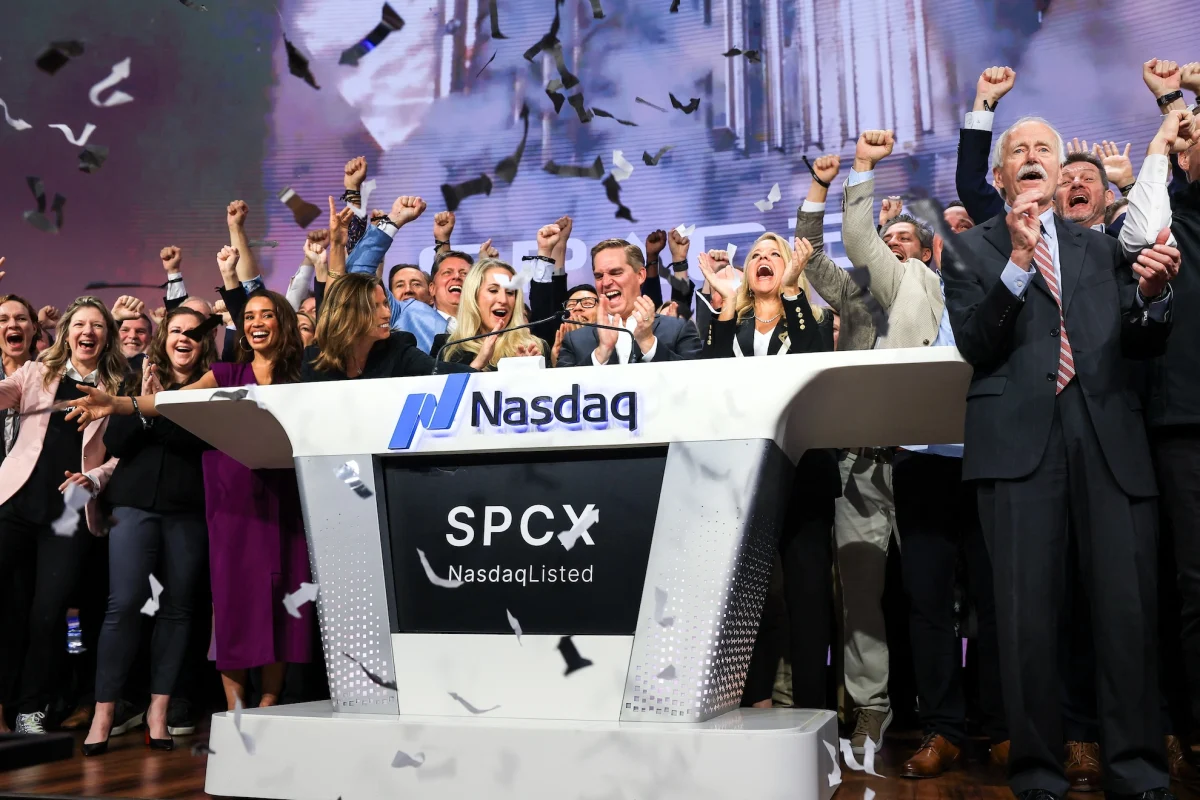
The eagerly anticipated initial public offering (IPO) of SpaceX, the private space exploration and satellite communications company, marked a historic moment on the Nasdaq exchange, immediately demonstrating robust investor confidence and a significant surge in valuation. Trading commenced with shares opening at $150, a substantial 11% increase over its official IPO price of $135 established just the day prior. This electrifying market debut propelled the company into an elite tier, attracting immense attention from institutional and retail investors alike.
Throughout its inaugural day of public trading, SpaceX’s stock price climbed even higher, peaking at an impressive $176 per share during midday activity. This peak pushed the company’s market capitalization to an extraordinary figure nearing $2.3 trillion, cementing its position as one of the most valuable enterprises globally, rivaling long-established technology giants. By the close of trading, the stock settled at $160.95, reflecting a remarkable 19% gain from its initial public offering price, signaling an unequivocal success for one of the most talked-about IPOs in recent memory.
A Decade-Spanning Journey to Public Markets
SpaceX’s journey to this monumental IPO is a narrative of audacious vision, relentless innovation, and profound disruption within an industry traditionally dominated by government agencies. Founded in 2002 by entrepreneur Elon Musk, with the ambitious goal of making life multi-planetary, the company initially faced skepticism and numerous technical hurdles. Its early years were characterized by a series of rocket launch failures and a continuous struggle for funding. However, SpaceX persevered, driven by its mission to drastically reduce the cost of space travel through reusable rocket technology.
Key milestones punctuate SpaceX’s rise. The successful launch and return of the Falcon 9 rocket in 2015 revolutionized the industry, proving the viability of reusable boosters and fundamentally altering the economics of space access. This was followed by the development of the Dragon spacecraft, which began ferrying cargo and later astronauts to the International Space Station for NASA, marking a pivotal shift towards commercial crew transportation. More recently, the Starlink satellite internet constellation, launched into low Earth orbit, has rapidly expanded, providing broadband access to underserved areas worldwide and establishing a significant recurring revenue stream for the company. Concurrently, the development of Starship, a fully reusable super heavy-lift launch system designed for deep space missions to the Moon and Mars, represents the zenith of SpaceX’s long-term aspirations.
For years, speculation about a SpaceX IPO had been rampant, often fueled by the company’s explosive growth and Musk’s public statements. The decision to go public at this juncture reflects a confluence of factors: the maturity of its core businesses (launch services, Starlink), the demonstrable profitability, and a robust market environment for high-growth tech and space ventures. While some anticipated a Starlink-specific IPO first, the full company offering suggests confidence in the collective value proposition and the integrated nature of its diverse operations.
Unprecedented Market Demand and Valuation
The intense demand for SpaceX shares was palpable even before trading began. Reports indicated that the IPO was oversubscribed by a factor of four, meaning that the interest from institutional investors far exceeded the available shares. This imbalance created a scarcity premium, with many large investment firms and hedge funds likely purchasing shares on the open market post-IPO to fulfill their desired allocations. This dynamic played a significant role in the immediate price surge observed on the Nasdaq.
A contributing factor to this scarcity and subsequent price appreciation was the relatively small float of publicly traded shares. Only about 4% of SpaceX’s total shares were made available for public trading, with the vast majority remaining in the hands of early investors, company executives, and employees. Such a limited supply, coupled with overwhelming demand, inevitably drives up prices, reflecting investor eagerness to gain exposure to a company with a near-monopoly on certain aspects of the commercial space sector.
Furthermore, SpaceX successfully navigated the complex landscape of index inclusion rules. By lobbying key indexes, such as the Nasdaq 100, to modify their criteria, the company secured a fast-tracked entry into these prominent benchmarks. This strategic move ensures that large passive funds and institutional portfolios tracking these indexes will automatically acquire SpaceX stock within days, rather than the typical months-long waiting period. This pre-planned demand injection further amplified the upward pressure on the stock price, demonstrating a sophisticated understanding of market mechanics.
The enthusiasm for SpaceX extended beyond institutional players to the retail investor community. Robinhood, a popular trading platform known for its accessibility to individual investors, reported "record-breaking" traffic on its platform during SpaceX’s debut day. This surge highlights the broad public interest in the company and its charismatic founder, indicating a widespread belief in the transformative potential of space exploration and satellite technology. The accessibility of trading platforms has increasingly allowed individual investors to participate in high-profile market events, often contributing to initial market volatility and price movements.
The Trillion-Dollar Man and Employee Windfalls
One of the most striking outcomes of SpaceX’s IPO was the financial milestone achieved by its founder, Elon Musk. The debut share price immediately catapulted his net worth to an unprecedented level, making him the world’s first trillionaire. This colossal accumulation of wealth, predominantly tied to his substantial stake in SpaceX, underscores the immense value the market places on his vision and leadership. While much of this wealth is on paper, contingent on the company’s sustained market performance, it nevertheless marks a new benchmark in personal fortune.
Beyond Musk, the IPO created a significant wealth redistribution among a large number of SpaceX’s dedicated workforce. The New York Times reported that approximately 4,400 current and former SpaceX employees became millionaires as a direct result of the company going public. Furthermore, an estimated 400 individuals within this group ascended to the status of centimillionaires, possessing fortunes exceeding $100 million. This broad-based employee wealth creation serves as a powerful testament to the long-term equity incentives offered by high-growth private companies and rewards the years of hard work, risk-taking, and innovation that fueled SpaceX’s ascent. These individual financial windfalls can have localized economic impacts, potentially stimulating real estate markets, luxury goods sectors, and philanthropic endeavors in areas where these newly minted millionaires reside.
The IPO also delivered historic returns for early venture capital investors who believed in SpaceX’s long-shot vision when others might have hesitated. Founders Fund, for example, which committed an estimated $600 million to the company, saw its stake surge to over $50 billion at the IPO price. Similarly, Andreessen Horowitz’s investment grew to be worth more than $10 billion, and Sequoia Capital’s stake was valued at over $20 billion. These staggering returns are among the largest in venture capital history, validating the high-risk, high-reward model of funding disruptive technologies and demonstrating the immense potential of patient capital in transformative industries.
Broader Implications for the Space Economy
SpaceX’s successful IPO and colossal valuation are poised to have far-reaching implications for the entire space economy, often referred to as "New Space." For decades, space exploration and utilization were primarily the domain of government agencies and a few large aerospace contractors. SpaceX fundamentally altered this paradigm, demonstrating that private enterprise could not only compete but also innovate more rapidly and cost-effectively. The company’s public market success provides a powerful validation for the commercial space sector, potentially attracting a new wave of investment into other private space ventures, from satellite manufacturers to asteroid mining startups.
This market validation could lead to increased competition, fostering further innovation across the industry. Other private space companies, both established players and emerging startups, may find it easier to secure funding, attract talent, and justify ambitious projects, buoyed by the precedent set by SpaceX. The public now has a tangible, highly liquid investment vehicle to participate directly in the space economy, which could democratize access to an industry previously considered niche.
The success of Starlink, in particular, highlights the burgeoning market for satellite-based services. Beyond internet connectivity, the proliferation of low Earth orbit (LEO) constellations promises advancements in Earth observation, navigation, and global communications, creating entirely new economic ecosystems. SpaceX’s ability to rapidly deploy and scale such a massive constellation has set a new standard for efficiency and ambition in satellite infrastructure.
Culturally, SpaceX’s IPO reinforces the narrative of humanity’s expansion into space, transforming what was once science fiction into a tangible future. The public’s enthusiasm, reflected in the stock market’s response, indicates a widespread belief in the importance and potential of space exploration, inspiring future generations to pursue careers in STEM fields and contribute to these grand endeavors.
Navigating Future Frontiers
Despite the triumphant IPO, SpaceX, like any rapidly expanding company, faces a spectrum of future challenges. The current valuation, while indicative of immense potential, also carries the weight of high expectations. Maintaining such a high growth trajectory will require continuous innovation, efficient execution, and the successful scaling of its diverse operations, from launch services to Starlink and the ambitious Starship program.
Technical hurdles, particularly with Starship’s development and testing, remain significant. Regulatory landscapes, both domestic and international, for space operations and satellite deployment are constantly evolving and could impact future expansion. Competition from established aerospace firms and other burgeoning private space companies will likely intensify, requiring SpaceX to maintain its technological edge and cost efficiencies.
Furthermore, the social and ethical implications of extreme wealth concentration, exemplified by the world’s first trillionaire, will undoubtedly continue to be a subject of public discourse. The balance between rewarding innovation and addressing broader societal concerns about inequality is a complex challenge that will likely accompany SpaceX’s continued journey.
Ultimately, SpaceX’s IPO represents more than just a financial event; it is a profound statement about the maturity of the commercial space industry and the boundless possibilities it presents. As the company navigates the complexities of public markets, its trajectory will undoubtedly continue to shape the future of space exploration, technology, and global economic landscapes for decades to come.