Amir Mahmud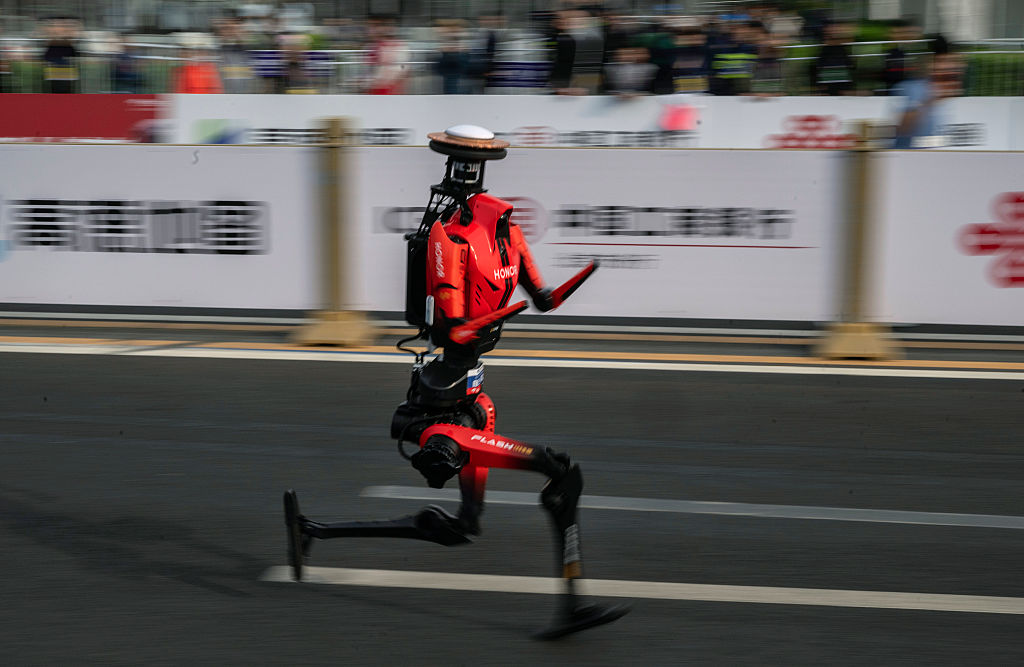
A groundbreaking competition in Beijing has spotlighted the astonishing progress in robotic locomotion, with humanoid machines completing a half-marathon distance in times that significantly surpass the fastest human achievements. The leading autonomous robot navigated the demanding 21.0975-kilometer course in an impressive 50 minutes and 26 seconds, a performance that comfortably eclipsed the existing human world record of 57 minutes and 31 seconds for the half-marathon, recently established by elite athlete Jacob Kiplimo. This remarkable feat not only underscores rapid advancements in artificial intelligence and mechanical engineering but also ignites fresh discussions about the evolving capabilities of machines in domains traditionally dominated by human endeavor.
A New Benchmark in Robotic Endurance
The recent Beijing event served as a powerful demonstration of how quickly robotic technology is advancing. The winning time represents a monumental leap forward from previous attempts. Just last year, the fastest robot participating in a similar half-marathon event struggled to complete the course, clocking in at a comparatively sluggish two hours and 40 minutes. This year’s dramatic reduction in finish time—by over 65%—is indicative of significant breakthroughs in power management, stability algorithms, and actuator efficiency, pushing the boundaries of what bipedal robots can achieve. While some might draw parallels to mechanical vehicles outperforming biological organisms, arguing such comparisons are inherently unequal, the sheer pace of improvement in robot performance within the span of a single year offers a compelling narrative of technological acceleration.
The Beijing E-Town Robotics Half-Marathon: A Crucible of Innovation
The competition unfolded within Beijing’s E-Town tech hub, a strategic industrial zone renowned for fostering high-tech innovation and advanced manufacturing. This state-backed district serves as a critical ecosystem for research and development in cutting-edge fields, including robotics, artificial intelligence, and new-generation information technology. The E-Town Robotics Half-Marathon is more than just a race; it functions as a critical testing ground and a public showcase for the latest advancements in humanoid robotics. By challenging machines to perform in a simulated real-world endurance scenario, organizers aim to accelerate development, identify areas for improvement, and spark public interest in the practical applications of robotics. The event draws participation from a diverse array of companies and research institutions, all vying to demonstrate the robustness and agility of their robotic platforms.
Engineering Triumph: Autonomy Versus Remote Control
The competitive landscape of the half-marathon was structured to evaluate different facets of robotic capabilities. Participants were divided into categories based on their operational modality: fully autonomous or remote-controlled. The robot that captured headlines for its record-breaking 50-minute and 26-second finish was an autonomous unit, developed by the Chinese smartphone giant Honor. While another Honor-built robot posted an even faster time of 48 minutes and 19 seconds, it operated under direct human remote control. The autonomous victor’s performance was ultimately deemed superior due to a weighted scoring system that prioritized self-governance and independent navigation over externally guided operation.
Approximately 40% of the robots in the competition operated autonomously, relying on onboard sensors, AI algorithms, and pre-programmed instructions to traverse the course without human intervention. The remaining 60% were piloted remotely, allowing human operators to guide their movements in real-time. This distinction is crucial for understanding the true significance of the autonomous robot’s achievement. Developing a machine capable of independently maintaining balance, adapting to terrain variations, and sustaining high-speed locomotion for an extended period represents a far greater engineering challenge than one guided by human intuition. The challenges encountered by some participants, such as a robot toppling at the starting line or another colliding with a barrier, underscore the inherent complexities of achieving stable, reliable bipedal motion, especially under strenuous conditions.
The Trajectory of Bipedal Robotics
The quest to create machines that emulate human locomotion has a long and fascinating history. Early attempts at bipedal robots often resulted in slow, jerky movements, prone to instability. Pioneers like Honda’s ASIMO, first introduced in 2000, marked significant milestones, showcasing the ability to walk, run, and even climb stairs, albeit with limited speed and endurance. Over the past decade, companies like Boston Dynamics have pushed the envelope further with highly dynamic robots such as Atlas, capable of complex parkour maneuvers. These advancements have been driven by innovations in sensor technology, sophisticated control algorithms, powerful actuators, and lighter, more durable materials.
The fundamental challenge in bipedal locomotion lies in dynamic balance. Unlike wheeled robots, which have continuous ground contact, bipedal systems must constantly adjust their center of mass to prevent falling, mirroring the complex biomechanics of human walking and running. This requires real-time processing of vast amounts of data from accelerometers, gyroscopes, and vision systems, combined with rapid, precise motor responses. The ability of the winning Honor robot to sustain a high pace for a half-marathon duration indicates a maturation of these core technologies, moving beyond mere demonstration of agility to genuine endurance and efficiency. The evolution from early, ponderous walking machines to today’s swift half-marathoners illustrates a remarkable trajectory of engineering ingenuity and computational power.
Beyond the Finish Line: Implications for Technology and Society
The implications of such rapid progress in humanoid robotics extend far beyond competitive racing. The capabilities demonstrated in Beijing hint at a future where bipedal robots play increasingly vital roles across various sectors.
Market Impact
In the commercial sphere, advanced humanoid robots could revolutionize logistics, performing tasks in warehouses, factories, and even last-mile delivery. Their ability to navigate complex, human-centric environments makes them ideal for spaces not designed for traditional wheeled or tracked robots. In hazardous environments, such as disaster zones or areas contaminated with toxic substances, humanoids could conduct search and rescue operations, inspection, and maintenance, significantly reducing risks to human life. Furthermore, their potential applications in elder care, assistive living, and personal companionship are areas of intense research and development, promising to address pressing societal needs. The economic impact could be substantial, fostering new industries, creating specialized jobs in robotics development and maintenance, and enhancing productivity across numerous sectors.
Social and Cultural Resonance
The public’s reaction to advanced robotics is often a mix of fascination and apprehension. Events like the Beijing half-marathon spark important conversations about the future of human-machine interaction. The "my car can outrun a cheetah" analogy, while dismissive, encapsulates a common sentiment: that comparing human and machine performance can be misleading or even unsettling. However, such comparisons also serve to highlight the distinct strengths of each. Humans possess adaptability, intuition, and emotional intelligence, while robots excel in precision, endurance, and computational power.
Culturally, these advancements challenge traditional notions of physical prowess and skill. As robots demonstrate capabilities once thought exclusive to humans, society must grapple with questions of identity, purpose, and the boundaries of artificial intelligence. Ethical considerations, such as job displacement, accountability in autonomous systems, and the potential for misuse, become increasingly pertinent as robots integrate more deeply into daily life.
The Future of Human-Robot Collaboration
Rather than viewing robots solely as competitors, the focus is increasingly shifting towards collaboration. The skills honed in developing these marathon-running robots—stability, energy efficiency, sophisticated navigation—are directly transferable to robots designed to work alongside humans. Imagine construction sites where humanoids assist with lifting and carrying, or hospitals where they deliver supplies and support medical staff. The rapid improvements in bipedal locomotion are not just about speed; they are about creating more versatile, capable, and ultimately, more useful robotic companions and tools.
Analytical Perspective: The Road Ahead
The Beijing half-marathon stands as a powerful testament to the accelerating pace of innovation in robotics. The transition from a two-hour-plus finish to under an hour in just one year is not merely incremental progress; it signifies a potential inflection point. This rapid improvement suggests that foundational challenges in bipedal dynamics and energy efficiency are being overcome at an unprecedented rate.
However, significant hurdles remain. While speed and endurance are impressive, real-world deployment demands robust performance across varied, unpredictable terrains and in diverse weather conditions. The instances of robots falling or hitting barriers highlight that perfect reliability is still an elusive goal. Further advancements are needed in tactile sensing, real-time environmental perception, and robust decision-making under uncertainty to enable robots to operate seamlessly in complex, unstructured environments. The weighted scoring system in the competition also underscores the ongoing emphasis on true autonomy, which is crucial for widespread, practical application beyond controlled environments.
Competitive events like the E-Town half-marathon play a vital role in pushing the boundaries of what is possible. They provide a public platform for showcasing progress, foster healthy competition among developers, and encourage innovative solutions to complex engineering problems. As these machines continue to evolve, their presence will undoubtedly reshape industries, alter our understanding of physical limits, and prompt ongoing societal dialogues about the role of advanced technology in shaping human destiny. The finish line of this robot race is merely a starting point for exploring an increasingly intertwined future between humans and intelligent machines.