Amir Mahmud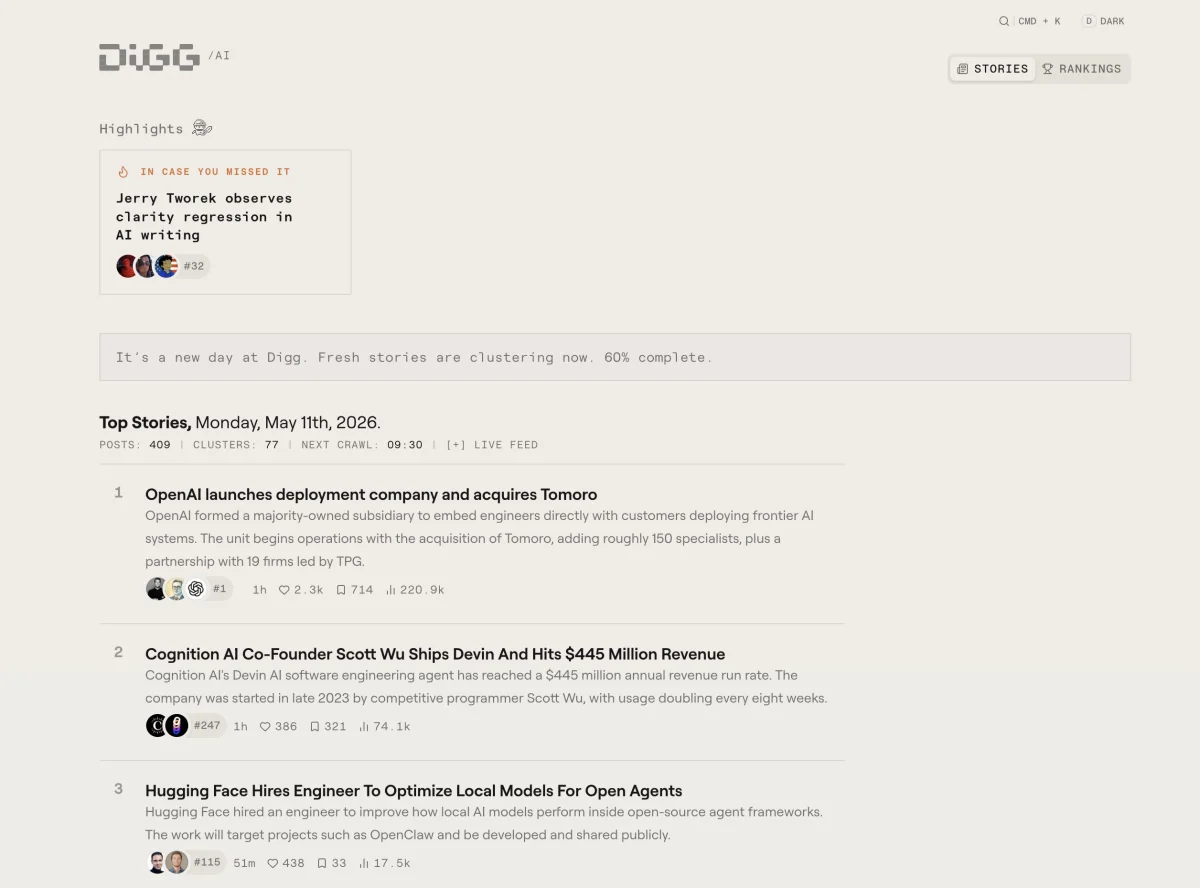
The digital landscape, ever in flux, witnesses the remarkable return of a familiar name: Digg. Just months after its most recent attempt to re-establish itself faltered, the pioneering link-sharing platform is embarking on yet another ambitious pivot, repositioning itself as an artificial intelligence-powered news aggregator. This latest iteration marks a significant departure from its previous social forum aspirations, signaling a strategic embrace of cutting-edge technology to navigate the complexities of modern news discovery.
A Legacy Forged in the Early Web 2.0 Era
To understand Digg’s persistent re-emergence, one must revisit its origins. Launched in December 2004 by founder Kevin Rose and his team, Digg rapidly became a hallmark of the burgeoning Web 2.0 movement. In an internet environment still largely dominated by static websites and traditional news portals, Digg offered a revolutionary, democratized approach to content discovery. Users, rather than editors, determined the prominence of news stories, articles, and videos through a simple "digg" or "bury" voting system. This peer-driven curation model resonated deeply with early internet adopters, fostering a vibrant community where quality content, regardless of its source, could quickly rise to prominence.
Digg’s innovative mechanism for surfacing user-voted content captured the zeitgeist of an internet yearning for participation. It created a level playing field, allowing independent bloggers and niche publications to compete for attention alongside established media giants. The platform’s success was meteoric, transforming it into a daily habit for millions and a significant traffic driver for countless publishers. It cultivated a distinct culture, where the "Digg effect"—a massive surge in traffic from a front-page listing—was a coveted phenomenon. This era cemented Digg’s place as a foundational social news platform, influencing the design and functionality of countless subsequent social media sites and news aggregators. Its rise coincided with, and in many ways contributed to, the shift from a passive consumption model of media to an interactive, community-driven one.
The Downfall and Cycles of Reinvention
Despite its early triumphs, Digg’s journey has been punctuated by significant challenges and periods of decline. The most notable setback occurred with the launch of Digg v4 in August 2010. This controversial overhaul replaced the user-centric voting system with an algorithm that prioritized content from major publishers and introduced forced advertising, fundamentally altering the platform’s core appeal. The user community, feeling alienated and disenfranchised, reacted with widespread outrage, leading to a mass exodus to competing platforms, most notably Reddit. Reddit, which had started as a Digg alternative in 2005, capitalized on Digg’s misstep by maintaining its commitment to a community-driven, user-moderated model, absorbing much of Digg’s disaffected user base. This event serves as a cautionary tale in the annals of internet history, illustrating the critical importance of community trust and user engagement in platform development.
Following this dramatic decline, Digg underwent a series of acquisitions and reboots, each attempting to recapture its former glory or find a new niche. It was acquired by Betaworks in 2012, then by Blockstack (later Hiro Systems) in 2018, and subsequently sold again to a different entity. These iterations explored various formats, from a sleek RSS reader to a curated magazine-style interface, but none managed to ignite the widespread enthusiasm of its early years. Each attempt highlighted the difficulty of re-establishing a brand’s relevance in a rapidly evolving digital ecosystem, particularly one that had lost its original community bedrock.
The most recent attempt, launched only a few months prior to this latest pivot, aimed to directly challenge Reddit by re-embracing a community-driven, link-sharing forum model. However, this endeavor quickly encountered formidable obstacles. The platform struggled with an influx of bot traffic, which undermined the integrity of its community interactions and content curation. Furthermore, it failed to sufficiently differentiate itself in a crowded market already dominated by established giants like Reddit, which boasts decades of accumulated user-generated content and robust community moderation tools. This led to staff layoffs in March and a swift return to the drawing board for the company’s leadership. Kevin Rose, a partner at True Ventures, once again stepped back into a full-time operational role in April, signaling a renewed, hands-on approach to steering Digg’s future.
The AI-Powered Aggregator: A New Direction
The latest incarnation of Digg, previewed by Rose in a recent social media post, represents a radical transformation. The platform has shed its aspirations of being a Reddit clone, instead reverting to a news aggregator format, but with a crucial modern twist: artificial intelligence. This time, Digg is specifically targeting the burgeoning field of AI news, using it as a proving ground for its new methodology before potentially expanding to other topics.
The core objective, as outlined in an email to beta testers, is to "track the most influential voices in a space" and "surface the news that’s actually worth paying attention to." This mission directly addresses the prevalent issue of information overload in the digital age, where users are constantly bombarded with content and struggle to discern what is genuinely significant. The initial focus on AI news is strategic, capitalizing on a rapidly evolving sector with a highly engaged, yet often overwhelmed, audience. While still in a "raw and buggy" beta phase, this early look offers a glimpse into Digg’s ambitious technological gambit.
Under the Hood: AI-Driven News Discovery
The redesigned Digg homepage presents news in a structured yet dynamic format. It prominently features four key stories at the top: the most viewed, a story experiencing rising discussion, the fastest-climbing narrative, and an "In case you missed it" headline. Below this curated selection, a ranked list of top stories for the day is displayed, complete with engagement metrics.
What truly differentiates this new approach is where these engagement metrics originate. Unlike its predecessors, which relied on internal user votes, the new Digg actively ingests and analyzes content from X (formerly Twitter) in real-time. This external data stream is then processed using sophisticated AI techniques, including sentiment analysis, clustering, and signal detection. These algorithms work in concert to identify not just what is being discussed, but also the underlying sentiment, the formation of discussion clusters around specific topics, and the emergence of significant signals from key influencers.
Kevin Rose highlighted the efficacy of this method by pointing to the impact of prominent figures like OpenAI CEO Sam Altman. According to Rose, when individuals of Altman’s stature engage with an AI-related story on X, it invariably triggers a ripple effect of deep discussion and widespread propagation across the platform. The new Digg is designed to precisely track and quantify this amplified engagement, theoretically providing a more accurate and immediate gauge of a story’s real-world impact and relevance. Beyond just news stories, the platform also features rankings of the top 1,000 influential individuals in AI, leading companies, and key politicians involved in AI issues, offering a comprehensive view of the ecosystem’s movers and shakers.
Navigating the Modern News Landscape: Opportunities and Challenges
Digg’s latest pivot arrives at a critical juncture for digital news consumption. The landscape is increasingly fragmented, with users relying on a mix of social media feeds, personalized algorithms, and direct subscriptions for their information. Traditional news aggregators have largely been supplanted, and the rise of generative AI has introduced new complexities. Google’s AI Overviews, for instance, often provide direct answers to user queries within search results, reducing the incentive to click through to original publisher websites and significantly impacting referral traffic. This environment makes news discovery both more challenging and potentially more valuable if executed effectively.
For "data nerds" and professionals deeply entrenched in specific fields like AI, Digg’s approach could prove invaluable. It promises to cut through the noise of general social media feeds, offering a focused, curated stream of highly relevant information driven by real-time influence. The ability to track signal among the cacophony of X, providing charts and graphs that visualize engagement impact, could offer a level of analytical insight not readily available elsewhere. Furthermore, if Digg manages to gain traction, it could serve as a much-needed source of website traffic for publishers whose businesses have been severely impacted by declining clicks from search engines and social media platforms.
However, significant challenges loom. The fundamental question remains: why would an everyday user choose Digg over their existing preferred news app, RSS reader, or even the algorithmically curated "For You" feed on X? The absence of direct community discussion on Digg’s own site, a feature that defined its early success and is central to platforms like Reddit, might limit its appeal for users seeking interactive engagement. Its heavy reliance on X for engagement metrics also presents a potential vulnerability. While AI news discussions currently thrive on X, the broader social media landscape is increasingly diversified. Many non-tech discussions, or even specific tech sub-communities, have migrated to platforms like Threads, Mastodon, or private messaging apps, or have retreated from the public internet entirely. This fragmentation could make it difficult for Digg to scale its model effectively to other topics where X might not be the primary locus of influential discourse.
Ultimately, Digg’s continued existence is a testament to the enduring vision of its founder and the team’s relentless pursuit of relevance. This AI-driven reincarnation is a bold technological bet, leveraging advanced analytics to address a genuine need for focused, high-signal news in a world drowning in data. Whether this sophisticated approach can attract and retain a broad user base, moving beyond niche appeal to reclaim a significant position in the competitive digital news ecosystem, remains the most compelling question for this digital phoenix.