Amir Mahmud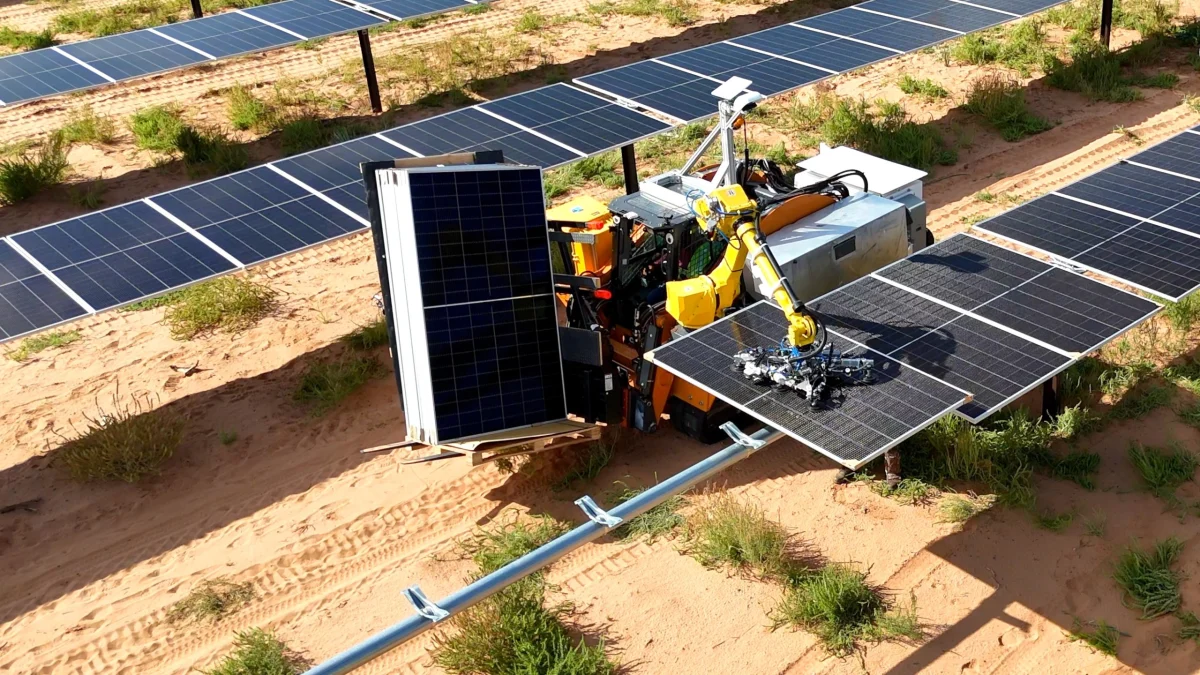
In a significant move poised to reshape the renewable energy landscape, Gritt, a robotics startup founded by two Carnegie Mellon roboticists, has emerged from stealth mode, announcing a total of $34 million in funding. This capital injection, including a recent $26 million Series A round led by Obvious Ventures with participation from Union Square Ventures and Active Impact Investment, alongside an earlier seed round from First Round Capital, Climactic, Congruent Ventures, and VSC Ventures, signals a robust belief in the company’s vision to tackle critical bottlenecks in solar infrastructure development. The core of Gritt’s innovation lies in deploying intelligent, AI-powered systems that utilize off-the-shelf hardware to automate the labor-intensive process of installing solar panels, thereby promising to accelerate the global transition to clean energy.
The Urgent Imperative for Solar Acceleration
The world stands at a critical juncture, grappling with the twin challenges of climate change and energy security. Nations globally are aggressively pursuing renewable energy sources, with solar power emerging as a cornerstone of these strategies due to its declining costs, scalability, and modularity. International agreements, such as the Paris Agreement, and ambitious national targets, including the U.S. goal to achieve a carbon pollution-free power sector by 2035, underscore the urgency. The solar energy build-out is not merely an environmental imperative; it is a geopolitical and economic necessity, promising energy independence and new industrial opportunities.
However, the rapid expansion of solar infrastructure faces formidable obstacles. While technological advancements have driven down the cost of solar panels and related components, the sheer scale of deployment required to meet global targets presents a significant logistical and labor challenge. Vast solar farms, sprawling across acres of land, necessitate the installation of millions of individual panels, a process that is both time-consuming and labor-intensive. This demand for rapid, large-scale deployment is often at odds with the realities of the modern construction labor market.
Overcoming the Labor Hurdle with Robotics
The construction industry worldwide has long grappled with a persistent labor shortage, a predicament exacerbated by an aging workforce and a dwindling interest among younger generations in physically demanding jobs often characterized as "dirty, dull, and dangerous." The solar installation sector is particularly susceptible to these pressures. Deploying solar panels, which can be large, heavy, and fragile, involves repetitive lifting, precise positioning, and working in outdoor, often challenging environments. A typical solar panel can weigh over 50 pounds, and crews might install hundreds per day, leading to significant physical strain, fatigue, and a higher risk of injury. This manual intensity creates a bottleneck, limiting the speed and efficiency with which new solar capacity can be brought online.
Historically, industrial robots have been confined to highly structured, predictable environments, such as automotive assembly lines, where tasks are repetitive and parameters are tightly controlled. The dynamic, unpredictable nature of outdoor construction sites—with varying terrain, weather conditions, and spatial layouts—has posed an insurmountable barrier for conventional automation. Until recently, deploying robots in such unstructured settings was largely impractical. However, the advent of advanced artificial intelligence models, particularly in areas like computer vision, machine learning, and reinforcement learning, has fundamentally altered this equation. These new AI capabilities enable robots to perceive, understand, and adapt to complex, real-world environments, opening the door for automation in previously intractable domains.
Gritt’s AI-First Strategy: A New Paradigm
Gritt’s co-founders, CEO Puneet Puri and CTO Vishal Dugar, both trained roboticists from Carnegie Mellon University, recognized this confluence of urgent market need and technological breakthrough. Their driving idea is not to reinvent the wheel by designing proprietary robotic hardware from scratch, but rather to develop an intelligent software layer that can control and coordinate off-the-shelf industrial equipment. This approach allows Gritt to leverage existing, proven machinery, such as rented skidders and robotic arms from manufacturers like Kawasaki, integrating them into a cohesive, AI-driven system. Puri articulates this vision as building an "intelligence which can work in the outdoor, chaotic environments of these construction sites, and it has to be generalizable enough that it can work in these varied environments."
The company’s initial application targets one of the most physically demanding and repetitive tasks in solar farm construction: the unloading, transport, and precise positioning of large glass solar panels onto metal frames. Gritt’s AI models guide these robotic platforms to handle the panels with sub-millimeter accuracy, preparing them for human workers to fasten them securely. This "software-first" strategy offers several distinct advantages. It potentially allows for faster development cycles, lower capital expenditure on specialized hardware, and greater flexibility in adapting to new tasks or different types of construction sites. By focusing on the intelligent control system, Gritt aims to achieve rapid scalability and a lean cost structure, which could be critical in a competitive, high-growth market.
Transforming On-Site Operations and Safety
The impact of Gritt’s technology on construction site efficiency and safety is already becoming evident. According to the company, an eight-person crew typically installs approximately 800 solar panels per day. However, when augmented by Gritt’s robotic systems, the same crew can achieve a significantly higher output, installing between 3,000 and 4,000 panels daily. This dramatic increase in productivity translates directly into faster project completion times, reduced labor costs per installed panel, and the ability for solar developers to meet aggressive deployment schedules.
Beyond mere speed, the social and human impact of this automation is profound. A customer, who chose to remain anonymous due to competitive concerns but expressed strong enthusiasm for the system, highlighted two key benefits. First, the robots make it easier to execute projects in remote locations where attracting and retaining a sufficient human workforce is challenging. Second, and perhaps more critically, the system is expected to substantially reduce injuries by minimizing the need for workers to repeatedly lift heavy, 100-pound panels overhead. This shift allows human workers to move from strenuous, injury-prone tasks to more supervisory, quality control, or skilled finishing roles, transforming the nature of work on a solar construction site.
Gritt’s early traction reflects this compelling value proposition. The company reports being contracted to assist in the installation of 2.8 gigawatts (GW) of solar panels over the next 18 months, with its customer base including three of the top ten U.S. power construction companies. The ambitious goal to have 48 of its systems operational within the next six months underscores the confidence in its technology and market demand.
The Competitive Landscape and Future Vision
Gritt operates within a nascent but rapidly evolving competitive landscape. Other companies, such as Luminous Robotics, Cosmic, and China’s Trinabot, are also developing robotic solutions for solar panel installation. However, a key strategic divergence lies in their approach: these competitors typically build their own proprietary hardware from the ground up, integrating their robotics and software into a single, specialized machine.
This distinction presents an interesting dynamic. While hardware-centric approaches might allow for highly optimized performance for specific tasks, they often entail higher research and development costs, longer iteration cycles, and greater capital expenditure for manufacturing and deployment. Gritt’s software-first, off-the-shelf hardware strategy, conversely, could offer greater agility, quicker deployment of new capabilities through software updates, and the potential to scale more rapidly by leveraging readily available industrial equipment. The success of each model will likely hinge on factors such as the cost-effectiveness of their solutions, their ability to adapt to varying site conditions, and the speed at which they can integrate new functionalities.
Gritt’s founders believe their approach, enabled by the latest advancements in AI, offers a distinct advantage in generalizability. Puri noted that training their system to stack cinder blocks took several weeks, but a similar demonstration for rebar tying, utilizing the same underlying software pipeline, was achieved in just one day. This rapid adaptation ability is central to Gritt’s ambitious future plans. Initially, the company aims to expand its system’s capabilities to include more manipulation tasks, such as fastening solar panels, drilling posts, and even constructing the racks upon which the panels sit.
Beyond Solar: A Broader Blueprint for Construction
The vision for Gritt extends far beyond solar farm construction. The company intends to apply its AI-powered robotics to other common, labor-intensive tasks across the broader construction industry. Tying rebar before concrete is poured, for instance, is another repetitive and physically demanding job ripe for automation. By developing a versatile AI platform that can be adapted to a multitude of construction tasks, Gritt aims to address the systemic productivity and safety challenges facing the entire sector.
Furthermore, the founders envision their intelligent systems doing more than just executing physical tasks. The suite of sensors and AI capabilities integrated into Gritt’s robots can serve as a "physical AI layer" that collects valuable data from worksites, enhancing management and decision-making. Imagine a robotic system detecting an open trench as a storm approaches, automatically alerting human workers to cover it before rain damages components, or flagging missing inventory in real-time. This predictive and assistive capability could transform site management, improving safety protocols, optimizing logistics, and preventing costly delays. Puri encapsulates this broader ambition: "Gritt becomes now this layer of physical AI, which is doing this dextrous, labor-intensive task, plus it can help you take decisions on the site."
The Dawn of Generalizable AI in Physical Work
Gritt’s emergence highlights a pivotal moment in the evolution of robotics and artificial intelligence. The past few years have witnessed profound breakthroughs in AI, moving beyond narrow applications to more generalizable models capable of learning and adapting across diverse contexts. This shift is particularly transformative for physical robotics, enabling machines to operate intelligently in the chaotic, unpredictable environments that define construction and other outdoor industries.
The promise of generalizable AI in physical work is immense, extending far beyond construction. It suggests a future where robots are not merely automated tools but intelligent collaborators, capable of augmenting human capabilities across a spectrum of industries—from logistics and agriculture to infrastructure maintenance and disaster response. As Gritt prepares to deploy its systems on a larger scale, it not only promises to accelerate the vital build-out of solar energy but also offers a compelling glimpse into the future of work, where human ingenuity and robotic efficiency combine to tackle some of humanity’s most pressing challenges.