Amir Mahmud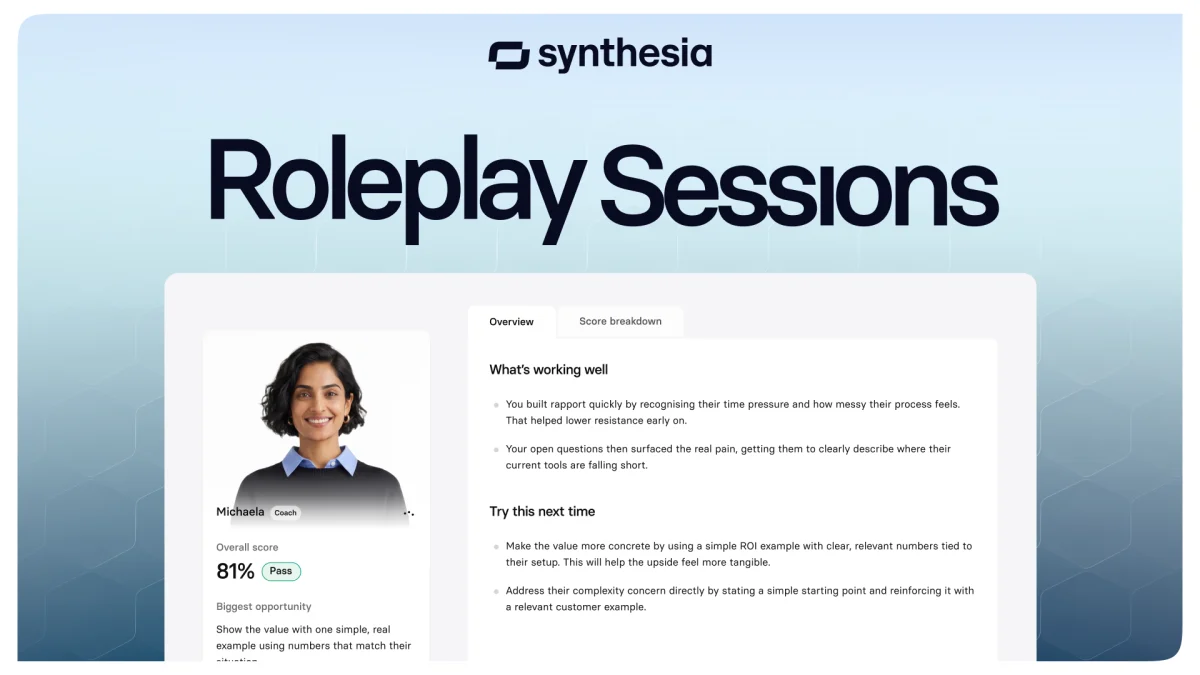
Synthesia, a British artificial intelligence innovator previously recognized for its rapid video creation platform, is charting a significant new course in the enterprise training landscape. The company has unveiled "Roleplay Sessions," an interactive product designed to move beyond passive information delivery to active skill development. This strategic pivot reflects a growing imperative within organizations to demonstrate tangible returns on their substantial AI investments, shifting the focus from mere content generation to measurable behavioral change and performance improvement.
The Evolving Paradigm of Corporate Learning
For decades, corporate training methodologies have undergone continuous evolution, striving to enhance employee capabilities and drive business outcomes. Traditional approaches often centered on classroom lectures, physical workshops, and printed manuals. With the advent of digital technology, e-learning modules, webinars, and on-demand video tutorials gained prominence, offering greater scalability and accessibility. Companies like Synthesia emerged as leaders in this digital transformation, leveraging AI to streamline the production of high-quality, interactive training videos, reducing both the time and cost associated with traditional content development. These innovations made it possible to deploy consistent training materials across vast workforces with unprecedented efficiency.
However, a fundamental challenge has persisted: the gap between knowledge acquisition and practical application. While employees might comprehend new concepts or procedures through engaging videos or presentations, translating that understanding into effective, real-world behavior often requires more than just passive consumption. Learning science consistently underscores the importance of active practice, repetition, and immediate, constructive feedback for true skill mastery and behavioral change. Many corporate training programs, despite their sophisticated delivery mechanisms, have fallen short of this crucial experiential component, leading to questions about their ultimate efficacy in altering on-the-job performance. Enterprises are increasingly scrutinizing whether their substantial investments in learning and development truly yield the desired shifts in employee conduct and, consequently, business results. This critical examination forms the backdrop for Synthesia’s latest strategic move.
Roleplay Sessions: Bridging the Practice Gap
Roleplay Sessions represents a significant leap in AI-driven experiential learning. The platform empowers employees to engage in simulated, high-stakes conversations with sophisticated AI avatars. Imagine a sales professional honing their pitch, a manager practicing a delicate performance review, or a customer service representative navigating a complex complaint scenario – all within a safe, virtual environment. The AI avatar is programmed not merely to respond, but to actively "push back," mimicking the unpredictable nature of real human interaction. This dynamic engagement forces the user to think on their feet, adapt their communication style, and apply learned principles under pressure.
Crucially, the system goes beyond mere interaction. Following each simulated conversation, the AI provides objective, rubric-based feedback, scoring the user’s performance against predefined criteria. This immediate and unbiased assessment highlights areas of strength and identifies specific opportunities for improvement, offering actionable insights that are often difficult to achieve with human-led role-playing, which can be subjective, time-consuming, and resource-intensive. This blend of immersive practice and analytical feedback is designed to foster genuine behavioral change, moving beyond rote memorization to true skill development. Victor Riparbelli, CEO and co-founder of Synthesia, emphasized this shift, noting, "Video performs way better than text or sending out a document. But for most things, we learn the best by actually practicing something rather than just reading it."
Technological Underpinnings and Strategic Differentiation
The technological foundation of Roleplay Sessions combines Synthesia’s proprietary innovations with advanced capabilities from leading AI providers. While Synthesia’s sophisticated avatar and voice synthesis technologies create hyper-realistic digital human interfaces, the underlying reasoning and conversational intelligence are powered by large language models (LLMs) from companies like OpenAI. This hybrid approach allows Synthesia to leverage the cutting-edge generative AI capabilities of external providers for natural language understanding and generation, while maintaining control over the visual and auditory presentation, ensuring brand consistency and user experience.
This integration is more than a technical feat; it signifies a shrewd strategic repositioning for Synthesia. In an increasingly crowded market for AI-generated content, where the ability to create video or text is becoming increasingly commoditized, Synthesia is carving out a more defensible niche. By integrating performance rubrics, granular data collection, and analytical insights, the company is transforming itself from primarily an AI avatar provider into a comprehensive performance-management platform. The interactive front-end, powered by AI avatars, becomes a sophisticated tool for data acquisition and skill development, providing organizations with unprecedented visibility into their workforce’s capabilities. This shift positions Synthesia to offer a unique value proposition that extends far beyond simple content creation, focusing instead on measurable human capital development.
Measuring Impact: Data-Driven Performance Enhancement
One of the most compelling aspects of Roleplay Sessions for enterprises is its capacity for data-driven insights. In an era where every business decision is increasingly informed by metrics, the ability to quantify soft skills and conversational proficiency is invaluable. When an entire sales team, for instance, engages with the AI role player, the platform can aggregate detailed performance data across the group. This allows managers and executives to gain a holistic and granular understanding of their sales force’s overall capabilities, identify collective strengths, pinpoint common weaknesses, and tailor subsequent training interventions with precision.
This level of analytical depth was previously challenging, if not impossible, to achieve consistently. Traditional performance reviews often rely on subjective observations or infrequent evaluations. Roleplay Sessions provides objective, consistent data points that can inform talent mapping, identify high-potential individuals, and even help in succession planning. Riparbelli highlighted this managerial appeal: "From a managerial executive layer, we’re seeing huge interest in mapping out the talent in their company in a way that’s been really difficult to do before." The platform’s ability to track progress over time and demonstrate tangible improvements in critical soft skills like negotiation, empathy, and conflict resolution offers a clear pathway to proving the return on investment for training programs, a key driver for enterprise adoption in the current economic climate.
Early Adoption and Broadening Horizons
Synthesia’s Roleplay Sessions is already gaining traction among prominent global organizations, signaling strong market validation for its innovative approach. The company has secured early commercial rollouts with a diverse set of high-profile clients, including "one of the top three companies by market cap in Europe, one of the top five Fortune 100, and one of the biggest recruitment companies in the world," according to a company spokesperson. These early adopters are leveraging the platform primarily for two critical use cases: enhancing sales team capabilities and developing leadership soft skills. This includes practicing complex sales pitches, refining negotiation tactics, and mastering the art of navigating difficult conversations, all essential for modern professional success.
While currently an enterprise-focused offering, Synthesia harbors ambitious plans for broader accessibility. The company intends to expand Roleplay Sessions to small businesses, prosumers, and even educational institutions in the coming months. This expansion is predicated on the ongoing reduction in "inference costs" – the computational expense associated with running AI models. As these costs continue to fall, advanced AI-powered training solutions will become economically viable for a wider array of users, democratizing access to high-quality, personalized coaching that was once the exclusive domain of large corporations. This future vision positions Roleplay Sessions not just as a corporate tool, but as a potential catalyst for skill development across various sectors and individual learners.
The Broader Implications for Enterprise AI
Synthesia’s move into interactive, practice-based AI training signifies a crucial inflection point in the broader adoption of artificial intelligence within enterprises. The initial wave of AI integration often focused on automating repetitive tasks or generating content for efficiency gains. However, a new phase is emerging, characterized by a demand for demonstrable, measurable business outcomes. Companies are moving beyond the allure of "cool tech demos" and are increasingly demanding proof that their AI investments are translating into tangible improvements in productivity, revenue, and human capital development.
This shift has profound implications for the future of work and learning. AI-powered role-playing could revolutionize how soft skills – critical yet often difficult to teach and assess – are developed. It offers a scalable, consistent, and personalized alternative to traditional methods, addressing the limitations of human trainers in terms of availability, cost, and potential for bias. However, neutral analytical commentary also suggests that while AI excels at structured practice and objective feedback, it may not entirely replicate the nuanced empathy, spontaneous creativity, or complex emotional intelligence inherent in all human interactions. Organizations will need to strike a balance, leveraging AI for foundational skill development while reserving human mentorship and coaching for the most intricate interpersonal dynamics. Furthermore, ethical considerations around data privacy, algorithmic bias in scoring, and the potential for over-reliance on AI for professional development will remain important discussion points as these technologies become more pervasive.
In conclusion, Synthesia’s Roleplay Sessions represents a significant step forward in the application of AI for human development. By emphasizing active practice and measurable feedback, the platform aims to unlock a new level of efficacy in corporate training. This strategic evolution not only strengthens Synthesia’s position in the competitive AI market but also signals a broader trend: the enterprise world’s increasing demand for AI solutions that deliver not just efficiency, but demonstrable, transformative impact on individual and organizational performance.