Amir Mahmud
In a significant development for the field of artificial intelligence and robotics, Enigma, a stealth-mode research laboratory, has announced a substantial $70 million seed funding round. This capital infusion, led by prominent venture firms Index Ventures and Ribbit Capital, with additional participation from Sarah Guo of Conviction Partners, signals a strong belief in Enigma’s unconventional approach to one of AI’s most formidable challenges: making complex robotic systems as effortlessly controllable as everyday household appliances. While many contemporary robotics companies are focused on developing sophisticated foundation models capable of performing a wide array of tasks without explicit training, Enigma is carving out a distinct path, prioritizing the intricate dynamics of human-robot interaction to build truly intuitive interfaces and potentially entirely novel robotic architectures.
A New Paradigm in Robotics Control
The ambition to create robots that can understand and execute tasks with minimal human intervention is a long-standing quest in artificial intelligence. Current research often involves diverse methodologies, ranging from analyzing vast datasets of web videos and running extensive computer simulations to capturing granular human motion data using sensor-equipped gloves. These efforts primarily aim to enhance the robotic models’ intrinsic capabilities and dexterity. Enigma, however, posits that the true bottleneck to widespread robotic adoption lies not just in the robots’ inherent abilities but in the efficacy and simplicity of the human-machine interface.
The company, less than a year old, is embarking on a mission to deeply understand how humans naturally wish to communicate with machines. This focus on the human element, rather than solely on the robotic "brain" or physical dexterity, represents a philosophical shift. Their hypothesis is that by meticulously studying these interactions, they can unlock designs for intuitive control mechanisms and, in turn, inspire a fundamentally different kind of intelligence within robotic systems. This approach challenges the prevailing wisdom that more capable models automatically lead to more usable robots, suggesting instead that usability itself might be the key to unlocking true potential.
The Evolution of Human-Machine Interfaces
The history of technology is replete with examples of how simplifying interaction has catalyzed mass adoption. From the complex punch cards and command-line interfaces of early computing to the graphical user interfaces (GUIs) that democratized personal computers, and further to the touchscreens and voice commands prevalent today, the trajectory has consistently moved towards more intuitive and less cognitively demanding modes of interaction. Each leap in interface design has lowered the barrier to entry, transforming niche technologies into ubiquitous tools.
In robotics, this challenge is amplified by the physical nature of the interaction. Unlike software, a robot operates in the real world, subject to its complexities and unpredictable variables. Current methods of controlling advanced robots often require specialized training, intricate programming, or highly skilled operators, limiting their utility to industrial or highly specialized applications. This is precisely the gap Enigma aims to bridge. The vision is to move beyond the current state, where even highly capable AI models necessitate considerable effort and precision from human operators, making tasks like loading a dishwasher with a robot more tedious than doing it by hand. This "last mile" problem in robotics — translating complex AI capabilities into effortless real-world action — is where Enigma sees its opportunity.
From Cybersecurity to Embodied Intelligence: The Founders’ Journey
The genesis of Enigma is rooted in the unique backgrounds of its co-founders, Jonathan Jacobi and Gal Niv. Jacobi, notably Microsoft’s youngest-ever employee — a talent identified and recruited by Wiz founder Asaf Rappaport during his tenure at the tech giant — brings a history of precocious technical achievement. His partner, Gal Niv, shares a similarly impressive trajectory. The two met during their formative years, competing in intense hacking competitions, a crucible for developing sharp problem-solving skills and a deep understanding of complex systems. Their bond solidified during their mandatory service in Israel’s elite Unit 8200, an intelligence corps renowned globally for its advanced cybersecurity research and for incubating some of the nation’s most successful tech entrepreneurs and innovators. This unit has a rich history of fostering individuals with exceptional analytical capabilities and a penchant for tackling challenging, real-world problems.
Despite lacking direct prior experience in the robotics sector, Jacobi and Niv made a conscious decision last year to apply their formidable technical prowess to AI for robotics. They viewed it as a field ripe with the most exciting and significant unsolved problems in technology. This "outsider" perspective is, according to Shardul Shah, a partner at Index Ventures, a key strength. "There are a lot of robotics industry insiders participating in the next wave of embodied intelligence, but Jonathan and Gal are outsiders — they’re not roboticists," Shah observed. "It affords them more room for originality. Someone who’s an insider may start with the capability of teleoperation or dexterity, but Enigma is starting from a very different place: ‘What’s the ultimate experience?’" This fresh viewpoint allows them to question fundamental assumptions and explore avenues that might be overlooked by those entrenched in traditional robotics paradigms.
To realize their ambitious vision, the co-founders assembled a formidable team. Jacobi describes them as some of their "smartest friends" drawn from Israel’s vibrant tech ecosystem and community. This includes alumni from leading AI research labs, celebrated math Olympiad winners, and even several individuals who were persuaded to pause or drop out of PhD programs, reflecting the magnetic appeal of Enigma’s mission and the founders’ ability to attract top-tier talent.
Rethinking Human-Robot Interaction
Enigma’s core philosophy centers on making human-robot interactions completely effortless, a stark contrast to the current state where even advanced robotic systems demand significant cognitive load from users. Jacobi illustrates this point with a relatable analogy: "If you had to do your dishes and spent 15 minutes explaining to a robot where to put everything, everyone reaches the point of ‘Forget it, I’ll just do it myself,’” he explained. "Right now, everyone is at that point — even with the most capable models." This highlights a critical barrier to mainstream adoption: the perceived cost in time and mental effort often outweighs the benefit of automation.
The ultimate goal, as envisioned by Jacobi, is to make manipulating robots as intuitive and simple as adjusting a car’s volume knob. He argues that users would be profoundly frustrated if, instead of a simple turn of a dial, they were forced to adjust volume by precise percentages without knowing whether the resulting sound would be too loud or too quiet. This analogy powerfully conveys the desired level of intuitive, feedback-driven control that Enigma seeks to achieve. The car volume knob is a masterclass in direct manipulation, offering immediate, proportional feedback and requiring no explicit instruction or complex mental model from the user. Replicating this level of simplicity for complex robotic tasks represents a monumental challenge.
The Global Experiment: Decoding Intuition
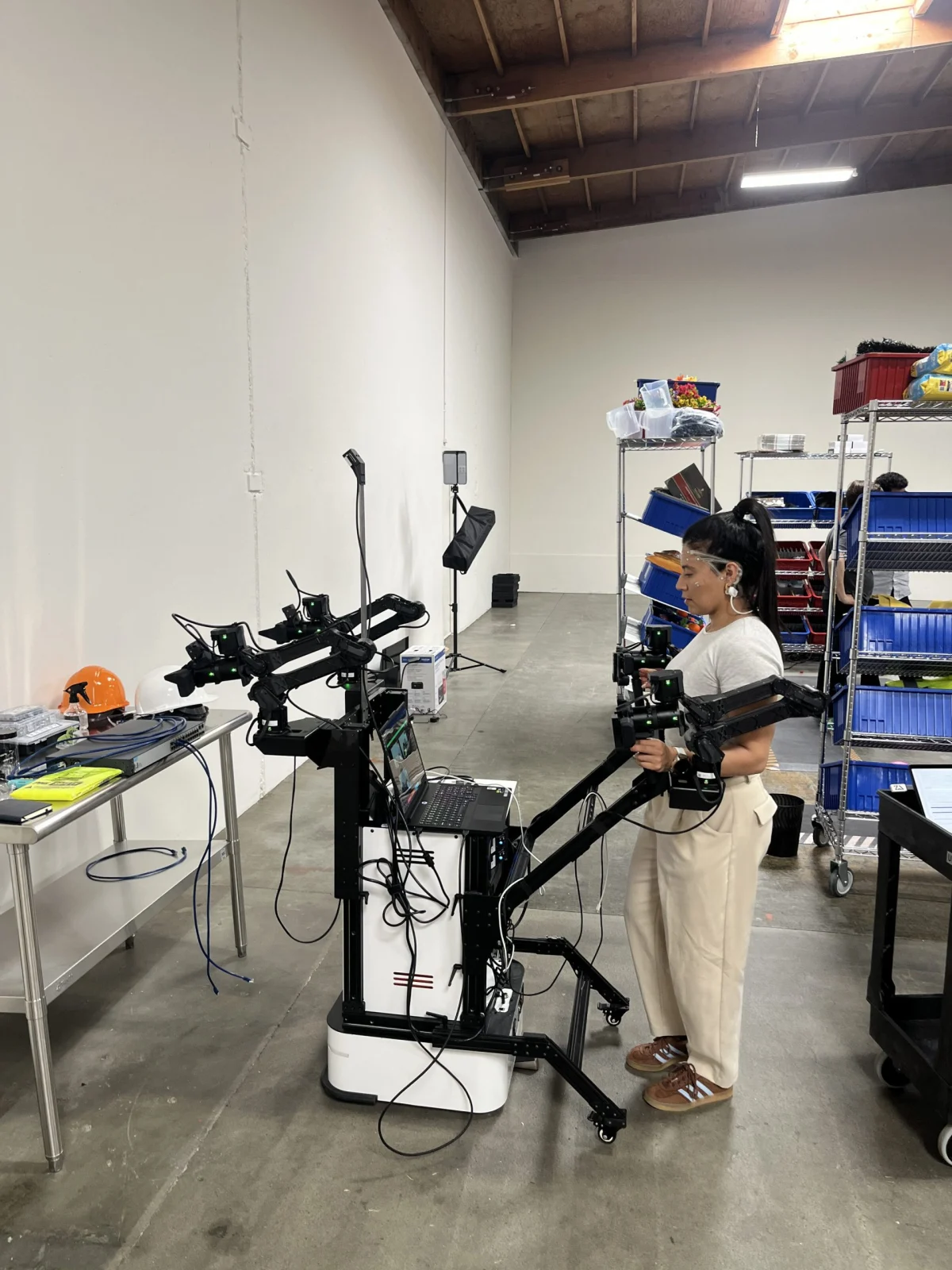
To gather the necessary data and insights for this ambitious endeavor, Enigma is launching a pioneering large-scale experiment. This initiative will allow anyone across the globe to interact online with over 100 of its proprietary AI robots. These robots are physically housed in dedicated facilities located in Israel and California, signifying a distributed and robust infrastructure for their research. The tasks these robots can perform are diverse and illustrative of real-world manipulation challenges: from the fine motor control required to draw pictures with a paintbrush, to the dynamic interaction of fighting each other with swords, and the precise handling needed for simple chemistry experiments involving picking up and mixing flasks with liquids. Enigma asserts that it has developed both the robotic arms and their foundational underlying models entirely from the ground up, underscoring their commitment to a holistic, integrated approach to robotics.
The public test aims to evaluate a multitude of potential communication methods between humans and robots. "We’re going to learn a lot about what is the right way to interact with robots," Jacobi elaborated. "Do we want to just talk to them over text or audio? Do we want to show them an example as a video? Or maybe do we want to tap, drag, and drop?" This open-ended experimental design is crucial for capturing unbiased human preferences, rather than imposing preconceived notions of interaction. By collecting real-world data on how people naturally attempt to direct and communicate with robots, the startup hopes to discover not only superior user interfaces but also more effective methods for training its foundational AI models. The interplay between intuitive control and robust AI learning is central to their strategy.
Broader Implications and Future Horizons
While the exact business use cases for Enigma’s AI currently remain, as the company’s name might suggest, somewhat an "enigma," the potential societal and economic impact of truly intuitive robotics is vast. Jacobi did indicate that the startup is already engaging in partnerships with companies across diverse sectors, including healthcare, logistics, and entertainment.
In healthcare, intuitive robots could assist with delicate surgeries, patient care, rehabilitation, or the sterilization of equipment, reducing strain on human staff and improving efficiency. In logistics, they could revolutionize warehousing, package sorting, and last-mile delivery, addressing labor shortages and enhancing supply chain resilience. For entertainment, the possibilities range from advanced animatronics and interactive exhibits to personalized home companions, pushing the boundaries of immersive experiences. Beyond these, one can envision applications in hazardous environments (e.g., disaster relief, space exploration), agriculture, education, and even domestic settings, where robots could perform chores or provide companionship for the elderly.
The broader market implications are profound. If Enigma succeeds in making robots accessible and easy to use for non-specialists, it could trigger a new wave of automation and innovation, potentially creating entirely new industries and job categories while redefining existing ones. The cultural impact could be equally significant, ushering in an era where robots transition from industrial tools to ubiquitous, helpful partners in daily life, fulfilling a long-held science fiction dream. However, this also brings forth important ethical considerations, such as the implications for employment, data privacy in human-robot interactions, and the safety and accountability of increasingly autonomous systems.
Enigma’s ambitious, human-centric approach, backed by significant funding and a team of exceptional talent, positions it as a compelling player in the rapidly evolving landscape of AI and robotics. By focusing on the "ultimate experience" of human-robot interaction, the company aims not just to build better robots, but to fundamentally change how humanity coexists and collaborates with intelligent machines. The journey to making robot control as simple as adjusting a volume knob is undoubtedly complex, but Enigma’s bold venture could very well pave the way for a future where advanced robotics seamlessly integrate into the fabric of human existence.