Amir Mahmud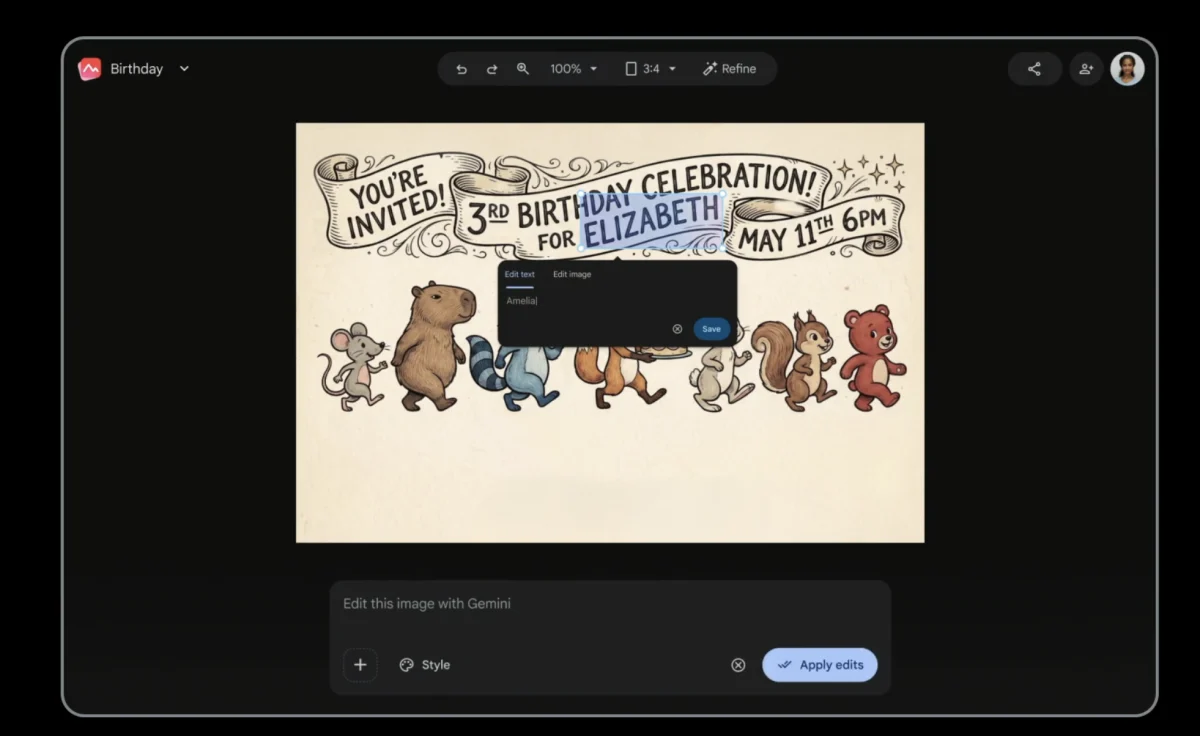
At its annual Google I/O 2026 developer conference, Google unveiled "Pics," a groundbreaking artificial intelligence-powered application designed to revolutionize visual content creation within the Google Workspace ecosystem. This strategic move signals Google’s intent to become a dominant force in the rapidly expanding AI design sector, offering an intuitive platform accessible to a wide array of users, from educators crafting lesson materials to small business owners developing marketing collateral.
Pics stands poised to empower individuals and organizations to generate high-quality images and design elements using simple text prompts, eliminating the need for specialized editing skills or complex software. The introduction of this app positions Google in direct competition with established design platforms like Canva, as well as emerging AI-native solutions such as Anthropic’s Claude Design. Google’s entry into this arena underscores the escalating importance of AI-driven design capabilities, marking it as a critical battleground for any enterprise reliant on compelling visual communication. The new application is currently being piloted by a select group of testers at I/O, with a broader rollout anticipated for Google AI Ultra subscribers later this summer.
The Evolution of Visual Creation: From Pixels to Prompts
The journey of visual content creation has undergone a profound transformation over the decades. Historically, professional graphic design was the exclusive domain of skilled individuals proficient in intricate software suites like Adobe Photoshop and Illustrator. These tools, while powerful, demanded extensive training and a deep understanding of design principles, creating a high barrier to entry for the average user. The rise of desktop publishing in the late 20th century began to democratize some aspects of design, but it wasn’t until the advent of web-based platforms like Canva in the early 2010s that visual creation truly became accessible to the masses. Canva, with its drag-and-drop interface and vast library of templates, allowed millions to produce professional-looking graphics without formal design education, fundamentally altering the landscape for small businesses, marketers, and casual users.
The most recent and perhaps most disruptive phase of this evolution began in the early 2020s with the public emergence of sophisticated generative AI models. Tools like DALL-E, Midjourney, and Stable Diffusion demonstrated the astonishing capability of artificial intelligence to conjure novel images from mere text descriptions. These early generative AI systems, while captivating, often presented their own set of challenges. Users frequently encountered difficulties in achieving precise control over outputs, fine-tuning specific elements, or making iterative changes without re-prompting the AI entirely. The initial promise of AI art was immense, but its practical application in a streamlined design workflow remained somewhat fragmented. Google’s Pics enters this context as a pivotal innovation, aiming to bridge the gap between raw AI generation and user-friendly, editable design, thereby ushering in a new era where visual ideas can be materialized and refined with unprecedented ease.
Pics: Bridging the Generation-Editing Divide
At its core, Pics is engineered for intuitive creation. Users can input straightforward text prompts to generate a diverse range of visual assets, including eye-catching social media graphics, personalized invitations, professional marketing materials, and conceptual mock-ups. This capability alone positions Pics as a formidable tool for rapid prototyping and content generation across various sectors. However, the true innovation lies in its approach to editing. Google has keenly identified a significant pain point with existing AI image generation models: the struggle to modify specific details within an almost-perfect output without inadvertently altering other desired elements or necessitating an entirely new generation process.
Pics addresses this limitation head-on by integrating a sophisticated, Gemini-powered editing layer that renders every element within a generated design or image fully adjustable. This means users are not confined to re-writing prompts for minor tweaks. Instead, they can directly interact with the visual content in multiple ways. A user might, for instance, highlight a particular object in an image and provide a new text prompt to change its color or texture, much like leaving a comment on a Google Docs file. Alternatively, for more straightforward modifications, Pics supports direct manual editing. Imagine creating a digital birthday invitation: if the time listed needs adjustment, a user can simply click on the time and type in the correct information, bypassing the need for any AI prompt whatsoever.
Underpinning Pics’ capabilities is Nano Banana 2, a generative AI model specifically chosen for its prowess in precise text rendering, deep real-world knowledge, and capacity for generating highly detailed visual outputs. This technological foundation ensures that Pics can not only create compelling imagery but also maintain high fidelity in text overlays and complex visual scenes. Furthermore, Pics’ native integration within Google Workspace is a strategic design choice, fostering a seamless workflow that enables visual collaboration across various Google applications, thereby enhancing productivity and creative synergy for teams and individuals alike.
Market Impact and Competitive Landscape
Google’s launch of Pics is poised to send ripples across the digital design market, potentially disrupting established players and reshaping user expectations for visual content creation. For individual users and small to medium-sized businesses (SMBs), Pics represents a significant empowerment tool. It democratizes access to professional-grade visual content, reducing reliance on costly design agencies or the steep learning curve associated with complex software. This could lead to substantial cost savings and accelerate content creation cycles, enabling even the smallest ventures to maintain a strong visual presence. The ability to rapidly generate and iterate on marketing materials, social media posts, and internal communications at scale could fundamentally alter how these entities engage with their audiences.
The competitive landscape is set for intensification. Canva, a market leader in accessible design, will face direct pressure from Pics, particularly given Google’s app’s deep AI generation and editing capabilities embedded within a familiar ecosystem. While Canva has also been integrating AI features, Pics’ approach, particularly its advanced editable layers, could differentiate it significantly. Similarly, AI-native competitors like Anthropic’s Claude Design will need to innovate further to match Google’s comprehensive ecosystem integration and nuanced editing features.
Furthermore, Pics indirectly challenges established creative software giants like Adobe. While Adobe continues to dominate the professional design space with tools like Photoshop and Illustrator, and is actively developing its own generative AI features through initiatives like Adobe Firefly, Google’s strategy targets a broader segment of users who might previously have considered professional tools overkill or too expensive. By lowering the barrier to entry, Google could capture a substantial new user base, influencing future generations of designers and content creators. The social and cultural implications are also profound. As AI makes sophisticated visual creation ubiquitous, we may see an explosion of diverse content, but also a heightened need for visual literacy and critical evaluation of AI-generated media. The definition of "design" itself may evolve, with a greater emphasis placed on conceptualization and prompt engineering rather than manual execution.
Integration and Workflow: A Unified Ecosystem
One of the most compelling aspects of Pics is its deep, native integration into the Google Workspace suite. This is not merely an add-on; it is designed to be an intrinsic component of a user’s daily digital workflow. The synergy with applications like Google Docs, Slides, and Sheets is expected to be seamless, allowing users to move fluidly between text, data, and visual creation without ever leaving the Google ecosystem. This unified approach aims to reduce friction and enhance productivity, fostering an environment where creative ideas can be brought to life and collaborated upon with unprecedented ease.
Consider a marketing team preparing a presentation in Google Slides. Instead of exporting data, designing charts in a separate application, and then re-importing them, Pics could allow for on-the-fly generation of visually compelling data visualizations or custom imagery directly within the presentation interface. Similarly, a teacher using Google Classroom could instantly generate engaging educational graphics or worksheets. Once a design is finalized within Pics, users are provided with a range of straightforward options for dissemination and further collaboration. They can instantly download the image in various formats, copy it for quick pasting into other applications, send it to a printer, or share it directly with colleagues or clients. The ability to pass a design to another team member for a final round of edits, complete with comment-based feedback, mirrors the collaborative power that has defined Google Workspace for years, extending it now to the realm of sophisticated visual design. This integrated workflow is a critical differentiator, leveraging Google’s existing user base and ecosystem strength to provide a cohesive and powerful creative solution.
Challenges and the Future of AI Design
While Pics represents a significant leap forward, its journey, and indeed the broader trajectory of AI design, is not without challenges. Maintaining consistent quality and aesthetic coherence across a vast array of user prompts will be crucial. The potential for AI models to generate biased, inappropriate, or even misleading content also necessitates robust ethical guidelines, content moderation systems, and ongoing model refinement. Concerns around copyright and intellectual property for AI-generated assets will continue to evolve, requiring clear policies from platform providers like Google. Furthermore, as the market becomes saturated with more AI design tools, differentiation will become increasingly challenging, demanding continuous innovation to stay ahead. User adoption, despite the emphasis on accessibility, will also depend on how quickly individuals and businesses adapt to a new paradigm of design where prompting and refining AI outputs become core skills.
Looking ahead, the future of AI design, spearheaded by innovations like Pics, suggests a dynamic interplay between human creativity and artificial intelligence. We may see the role of traditional designers evolve, focusing more on strategic direction, curation, and the ethical implications of AI-generated content, rather than solely on manual execution. The line between creator and consumer could further blur, empowering a "citizen designer" movement. "Prompt engineering" – the art and science of crafting effective AI prompts – may emerge as a valuable skill. Google’s strategic entry with Pics underscores its commitment to not only providing the foundational AI infrastructure but also leading in the development of user-facing applications that harness this technology. The success of Pics will not only validate Google’s approach but also provide valuable insights into how AI can genuinely democratize creativity and reshape our visual world. As these tools become more sophisticated, the possibilities for creative expression and visual communication will undoubtedly expand in ways we are only just beginning to imagine.


 Azin Asro