Amir Mahmud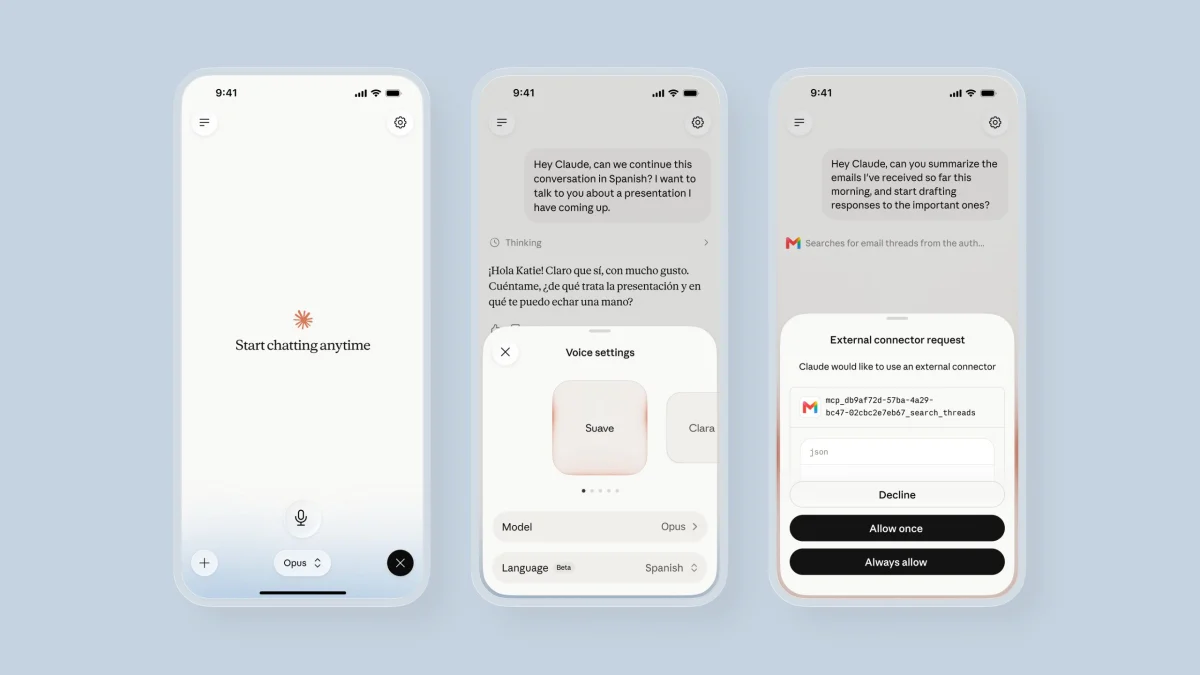
Anthropic, a prominent player in the burgeoning field of artificial intelligence, has significantly upgraded the voice mode for its flagship AI assistant, Claude. This strategic enhancement allows users to leverage the full spectrum of Claude’s advanced conversational models—Opus, Sonnet, and Haiku—through spoken interaction, marking a pivotal moment in the ongoing competition to deliver more intuitive and capable AI experiences. The move comes mere weeks after rival OpenAI introduced its own suite of refined conversational models and updated ChatGPT’s voice capabilities, underscor underscoring the rapid pace of innovation and the intense competitive pressure within the generative AI sector.
The Evolving Landscape of Conversational AI
The journey of voice-activated assistants has evolved dramatically over the past decade. From the rudimentary command-and-response systems of early virtual assistants like Apple’s Siri and Amazon’s Alexa, which primarily handled simple queries and smart home controls, the technology has progressed into sophisticated, large language model (LLM)-powered interfaces. These modern AI assistants are designed not just to execute commands but to engage in nuanced, context-aware conversations, understand complex intentions, and even generate creative content. This paradigm shift began in earnest with the widespread adoption of generative AI models, which transformed chatbots from rule-based systems into dynamic, adaptive conversational partners.
Anthropic itself introduced Claude’s voice mode approximately a year ago. At its initial launch, this feature was primarily powered by the Haiku model, known for its speed and efficiency in delivering quick responses. While effective for straightforward interactions, the original voice mode sometimes struggled with the depth and complexity required for more intricate tasks or extended dialogues. The ambition, shared across the industry, is to bridge the gap between human communication and machine interaction, making AI assistants feel less like tools and more like genuine collaborators. This latest update from Anthropic represents a significant stride toward that goal, aiming to make Claude’s voice interface as versatile and powerful as its text counterpart.
A Deeper Dive into Claude’s New Capabilities
The core of Anthropic’s recent update lies in its integration of Claude’s more powerful models directly into the voice mode. Previously, the voice interface defaulted to Haiku. Now, users gain the flexibility to choose between Opus, Sonnet, and Haiku, each offering distinct levels of intelligence, speed, and cost-efficiency. Opus represents Anthropic’s most advanced and capable model, excelling in complex reasoning, multi-step problem-solving, and nuanced understanding. Sonnet strikes a balance between performance and speed, making it suitable for a wide range of business and everyday applications. Haiku remains the fastest and most cost-effective option, ideal for quick, straightforward interactions where immediacy is paramount.
With this update, the voice mode intelligently defaults to the last model a user employed in their text chat session, and always utilizes its fastest available version. This seamless transition ensures continuity in the user experience, allowing for fluid shifts between text and voice interactions without losing the context or the computational power of the chosen model. For instance, a user might be drafting a complex analytical report using Opus in text chat and then seamlessly switch to voice to discuss parts of it, with Claude retaining the high-level reasoning capabilities of Opus.
The practical applications of these enhanced capabilities are vast and diverse. Anthropic highlights several use cases that underscore the deepened utility of the new voice mode. Users can now engage Claude in longer, more involved conversations, leveraging its advanced models for sophisticated tasks. This includes receiving detailed feedback on communication styles, an invaluable feature for professionals refining their presentation or negotiation skills. Preparing for a client pitch becomes more dynamic as users can verbally "talk through" their presentation, receiving real-time insights and suggestions from Claude. Furthermore, the enhanced voice mode is positioned as a powerful tool for brainstorming product market research, allowing teams to verbally explore ideas, analyze trends, and gather comprehensive insights without the friction of typing. These functionalities push Claude beyond a simple information retrieval system, positioning it as an active participant in complex professional workflows.
Strategic Differentiators: App Integrations and Model Flexibility
A key distinguishing factor for Anthropic’s updated voice mode, especially when contrasted with some of its competitors, is its robust integration with a suite of popular third-party applications. Claude’s voice mode can now tap directly into services like Gmail, Google Calendar, Slack, Canva, and Notion. This means users can issue voice commands to perform actions across these platforms, such as updating a meeting slot in their calendar, drafting an email, or creating a new document in Notion. This level of operational integration transforms Claude from a conversational agent into a true digital assistant capable of executing tasks across a user’s digital ecosystem.
This "tool-use" capability represents a significant strategic advantage. While many AI models excel at generating text or engaging in dialogue, the ability to interact with and manipulate data within other applications is crucial for real-world productivity. It streamlines workflows, reduces context switching, and allows users to accomplish multi-step tasks purely through voice. For example, a user could theoretically ask Claude to "Schedule a meeting with Sarah for next Tuesday at 10 AM to discuss the Q3 report, and then draft a brief agenda in Notion," all through a single voice command. This deep integration is a substantial differentiator, particularly as the AI industry moves towards creating more holistic and embedded AI experiences.
The Multilingual Frontier
Recognizing the global nature of its user base, Anthropic also made strides in expanding Claude’s multilingual support. Earlier in the year, a beta version of multilingual voice mode was introduced. Now, users can engage with Claude in a variety of languages beyond English, including French, German, Hindi, Indonesian, Italian, Japanese, Korean, Portuguese (Brazilian), and Spanish (Latin America/Spain). While users currently need to manually specify the language they intend to speak, this feature significantly broadens Claude’s accessibility and utility for diverse linguistic communities.
The development of multilingual AI assistants is a complex technical challenge, requiring vast datasets and sophisticated models to accurately process and generate speech in various languages, accounting for nuances in accent, dialect, and cultural context. Anthropic’s efforts in this area reflect a commitment to building a truly global AI, albeit with the current necessity for explicit language declaration indicating the ongoing refinement process. This expansion is crucial for capturing wider market segments and fostering greater inclusivity in AI adoption.
Navigating the Competitive Arena
The generative AI market is characterized by intense competition and rapid innovation. Anthropic’s latest update must be viewed within this broader context, particularly in light of OpenAI’s recent advancements. While OpenAI’s ChatGPT voice mode also saw updates to its conversational style and naturalness, Anthropic has chosen to emphasize the integration of its more powerful cognitive models and, crucially, its deep app integration capabilities. This strategic divergence highlights different philosophies in product development: one focusing on the raw conversational fluency and emotional intelligence of the AI, and the other prioritizing the AI’s ability to act as a functional agent within a user’s digital life.
Notably, Anthropic clarified that this release did not involve changes to the underlying voice model itself—the component responsible for speech-to-text and text-to-speech conversion, and aspects like interruption handling. This implies that while the cognitive capabilities of Claude’s voice mode have dramatically improved due to the integration of Opus and Sonnet, the conversational mechanics (e.g., how smoothly it handles interruptions or its vocal inflections) might not have seen the same level of refinement as OpenAI’s most recent offerings. This distinction is important for users who prioritize the naturalness of the interaction versus the functional power of the AI.
The new voice mode is currently available to all users in beta across various platforms. However, free users will experience some limitations, specifically being restricted to the Haiku model and only one connected application. This tiered access strategy is common in the AI industry, encouraging users to subscribe to premium plans for access to the most advanced features and models.
Market Implications and Future Prospects
The enhanced Claude voice mode carries significant market implications. By integrating with a broad ecosystem of enterprise and productivity tools, Anthropic positions Claude as a strong contender in the professional and business AI assistant market. The ability to seamlessly interact with work applications through voice can dramatically increase productivity, especially for tasks that involve frequent context switching or hands-free operation. This could drive greater adoption within corporate environments, where efficiency gains are highly valued.
From a social and cultural perspective, the increasing sophistication of voice AI heralds a future where human-computer interaction becomes even more natural and pervasive. As AI assistants become more capable of understanding complex requests and performing multi-step actions, they could fundamentally alter how individuals manage their personal and professional lives. The blurring lines between human and machine communication raise questions about the nature of assistance, productivity, and even companionship. The continued push for multimodal AI—where voice, vision, and text capabilities converge—suggests a future where AI interfaces are almost indistinguishable from human interaction in terms of versatility and responsiveness.
The long-term vision for voice AI is to move beyond mere transcription and command execution to truly intelligent, proactive assistance. Imagine an AI that not only understands your spoken words but anticipates your needs, offers relevant suggestions, and executes tasks across your digital environment with minimal prompting. Anthropic’s latest update for Claude’s voice mode, with its emphasis on powerful models and extensive app integrations, is a clear step towards realizing this ambitious vision. As the AI race continues to accelerate, we can expect further innovations that push the boundaries of what conversational AI can achieve, fundamentally reshaping how we interact with technology.
The Road Ahead for Voice AI
While Anthropic’s update is a significant leap, the journey for voice AI is far from over. Future developments will likely focus on improving the core voice models for even more naturalistic interactions, better handling of complex dialogues with multiple speakers, and deeper, more contextual integrations with an even wider array of applications. The ethical considerations surrounding AI voice, including data privacy, bias in language models, and the potential for misuse, will also remain critical areas of focus for developers and policymakers alike. As AI assistants become more intertwined with our daily lives, ensuring their responsible development and deployment will be paramount. Anthropic, with its stated commitment to safe and beneficial AI, is undoubtedly navigating these complex waters as it continues to refine Claude’s capabilities, striving to deliver an AI assistant that is not only powerful but also trustworthy and user-centric.