Amir Mahmud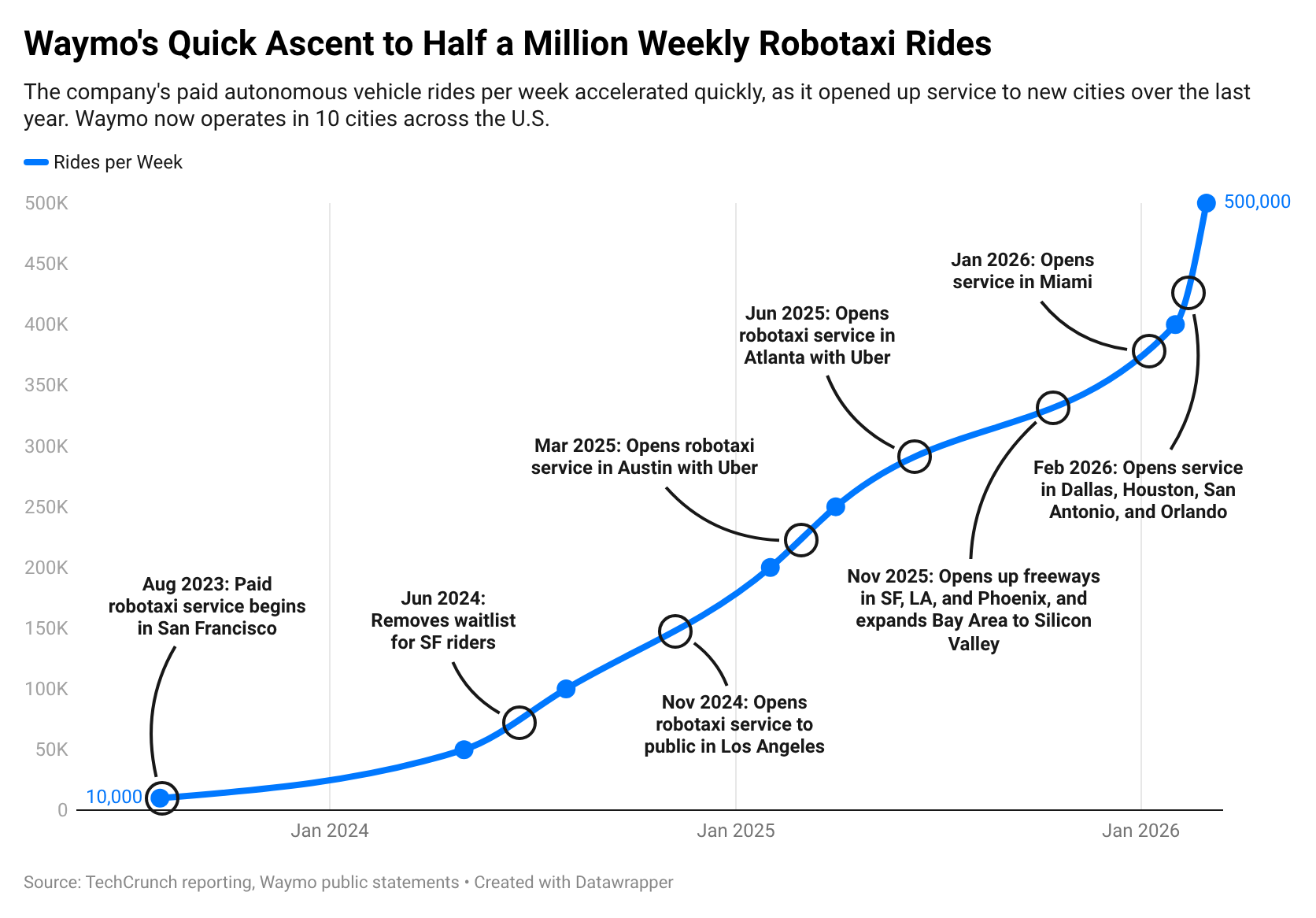
Waymo, a pioneering force in autonomous driving technology, has reached a significant operational milestone, now facilitating an astounding 500,000 paid robotaxi rides each week across ten distinct U.S. metropolitan areas. This impressive figure, recently disclosed by the Alphabet-owned company, underscores an accelerated commercialization strategy and reflects a burgeoning confidence in the viability of driverless transportation. The true narrative, however, lies not just in the sheer volume of trips but in the remarkable velocity of Waymo’s expansion in both ridership and market penetration.
A Decade of Development Culminates in Rapid Expansion
The journey to this operational scale began over a decade ago with Google’s ambitious self-driving car project, which spun off into Waymo in 2016. The initial vision was audacious: to develop a fully autonomous driving system capable of navigating complex real-world environments without human intervention. Early prototypes, often seen on public roads with safety drivers, gradually evolved through rigorous testing and iterative technological advancements. Waymo’s commitment to a multi-sensor approach, integrating lidar, radar, and cameras, contrasted with other strategies, positioning it as a leader in comprehensive environmental perception.
The transition from experimental prototypes to a commercially available service marked a pivotal moment. Waymo launched its first fully driverless public ride-hailing service in Phoenix, Arizona, in late 2017, initially as a limited trial before opening to the general public. This cautious yet groundbreaking rollout allowed the company to refine its technology and operational protocols in a controlled environment, gradually expanding its geofenced operational design domain (ODD) within the greater Phoenix area. Subsequent expansions into the dense, dynamic urban landscapes of San Francisco and Los Angeles further challenged and honed Waymo’s autonomous driving stack, preparing it for broader deployment.
The growth trajectory has been nothing short of exponential. In less than two years, the average weekly paid robotaxi trips provided by Waymo have surged tenfold, escalating from approximately 50,000 per week in May 2024 to the current half-million mark. This dramatic increase is paralleled by an aggressive geographical expansion. Beyond solidifying its presence in its initial markets of Phoenix, San Francisco, and Los Angeles, Waymo has strategically broadened its footprint into seven additional cities across the Sun Belt region within the past year alone. These new markets include Austin, Atlanta, Miami, Dallas, Houston, San Antonio, and Orlando, signaling a concerted effort to capitalize on regions with favorable regulatory environments, burgeoning populations, and suitable infrastructure for autonomous vehicle deployment.
Optimizing the Fleet: Efficiency and Technology
Central to Waymo’s ability to handle this burgeoning demand is the optimization of its vehicle fleet. While the company has historically been reticent about disclosing exact fleet figures, data submitted to the National Highway Traffic Safety Administration (NHTSA) in December 2025 indicated a fleet of 3,067 robotaxis equipped with its 5th generation self-driving system. Interestingly, Waymo has continued to refer to its fleet as "over 3,000" vehicles, suggesting a relatively stable count even as ridership has soared.
This stable fleet size, combined with the dramatic surge in weekly paid rides, suggests a significant improvement in vehicle utilization rates. Each robotaxi is evidently completing more trips per day, a crucial metric for the economic viability of autonomous ride-hailing. Maximizing the operational hours and revenue-generating potential of each vehicle is paramount for Waymo, particularly as autonomous vehicles represent a substantial capital investment. Empty robotaxis, whether cruising for passengers or repositioning, not only fail to generate revenue but can also contribute to urban congestion, a point of concern for city planners and residents alike. The ability to "squeeze more out of each robotaxi" is a testament to Waymo’s sophisticated dispatch and routing algorithms, which aim to minimize downtime and optimize passenger matching.
Looking ahead, Waymo is poised to further enhance its capabilities with the introduction of its 6th generation self-driving system. This next iteration of its autonomous technology is slated to debut on new vehicle platforms, specifically the Zeekr minivan, codenamed Ojai, and the Hyundai Ioniq 5. These new vehicle integrations promise improved performance, enhanced safety features, and potentially greater operational efficiencies, laying the groundwork for continued expansion and service refinement.
Navigating Regulatory and Public Scrutiny
Despite its impressive growth, Waymo’s journey is not without its challenges, particularly concerning regulatory oversight and public perception. As autonomous vehicles become more prevalent on public roads, so too does the scrutiny from government agencies and the general populace. Recent months have seen Waymo face increased examination, reflecting a broader trend of intensified oversight for the burgeoning AV industry.
For instance, both the NHTSA and the National Transportation Safety Board (NTSB) have initiated investigations into specific incidents involving Waymo robotaxis, including reports of "illegal behavior" around school buses. These inquiries highlight the critical need for autonomous systems to not only operate safely within general traffic but also to adeptly handle complex and sensitive scenarios, such as those involving vulnerable populations like schoolchildren. Each incident, regardless of its severity, contributes to the public’s perception of AV safety and can influence regulatory decisions.
Furthermore, Waymo has encountered pushback from local authorities, particularly in cities like San Francisco, where its robotaxis have been operational for a longer period. Concerns have been raised regarding how the company manages situations where its vehicles become unexpectedly stuck or disabled. Reports of Waymo occasionally relying on emergency services, such as police and firefighters, to clear its stalled vehicles have sparked debate about the operational burden autonomous fleets might place on municipal resources. These discussions underscore the need for AV companies to develop robust, self-sufficient roadside assistance protocols that minimize disruption to public services and ensure swift resolution of operational anomalies. Building public trust and demonstrating a commitment to seamless integration with urban infrastructure are crucial for long-term success.
The Competitive Landscape and Future Outlook
While Waymo holds a significant lead in the commercial robotaxi space, it is by no means operating in a vacuum. A diverse array of companies is actively vying for a share of the burgeoning autonomous ride-hailing market. Many of these competitors, however, are still in various stages of development and testing, with few offering fully autonomous, paid services to the public in the United States.
Internationally, Chinese robotaxi companies such as Pony.ai and WeRide have launched paid services in select cities within China, demonstrating advanced capabilities in their home market. However, none currently operate commercial robotaxi services in the U.S., where regulatory and market conditions differ considerably.
Domestically, the competition is heating up. Tesla, a prominent player in electric vehicles, initiated a paid robotaxi service in Austin in January, albeit with a different technological approach focused primarily on vision-based systems. CEO Elon Musk has frequently discussed the company’s aspirations for a fully autonomous ride-hailing service in California, yet reports indicate Tesla currently lacks the necessary permits to operate such a service there. Other notable contenders, including Avride, Motional (a joint venture backed by Hyundai), and Zoox (an Amazon subsidiary), are all actively pushing towards launching paid robotaxi services in various markets by the end of the current year. Motional, for example, has been integrating its robotaxis onto the Uber app in Las Vegas, showcasing a partnership model for market entry.
These companies, despite their progress, face a considerable challenge in catching up to Waymo’s established operational scale and accumulated real-world driving data. Waymo’s multi-year head start and extensive mileage in diverse urban environments have provided it with invaluable experience in refining its autonomous driving system and scaling its commercial operations.
Broader Implications for Urban Mobility
Waymo’s escalating ridership figures, while still a fraction of the human-driven ride-hailing behemoths like Uber (which completed approximately 13.5 billion ride-hailing and delivery trips in 2025, or over 1 million mobility trips per hour), signify a crucial shift in urban transportation. The rapid adoption of robotaxi services suggests a growing consumer appetite for autonomous mobility solutions, driven by factors such as convenience, potential for lower costs over time, and a novel experience.
The long-term implications of widespread robotaxi adoption are profound. Environmentally, a fully optimized, shared autonomous fleet could lead to reduced private car ownership, decreased traffic congestion, and lower carbon emissions, especially if the fleets are predominantly electric. Socially, autonomous vehicles hold the promise of enhanced mobility for individuals who cannot drive, such as the elderly, those with disabilities, or younger populations, thereby increasing accessibility and independence. Economically, the industry could create new job categories in fleet management, maintenance, and software development, even as it displaces traditional driving roles.
However, these benefits are intertwined with complex societal considerations. The potential impact on urban planning, parking infrastructure, and public transit systems will require careful foresight and collaboration between technology companies, city governments, and communities. The cultural shift away from personal car ownership, while potentially transformative, will also be gradual and influenced by factors like cost, convenience, and evolving consumer preferences.
As Waymo continues to expand its lead in the burgeoning robotaxi market, each passing month brings the vision of autonomous urban mobility closer to a widespread reality. The challenges ahead are significant, ranging from perfecting the technology to navigating regulatory complexities and winning over public trust. Yet, Waymo’s current trajectory firmly establishes it as a frontrunner in a race that promises to redefine how people move within cities for generations to come.