Amir Mahmud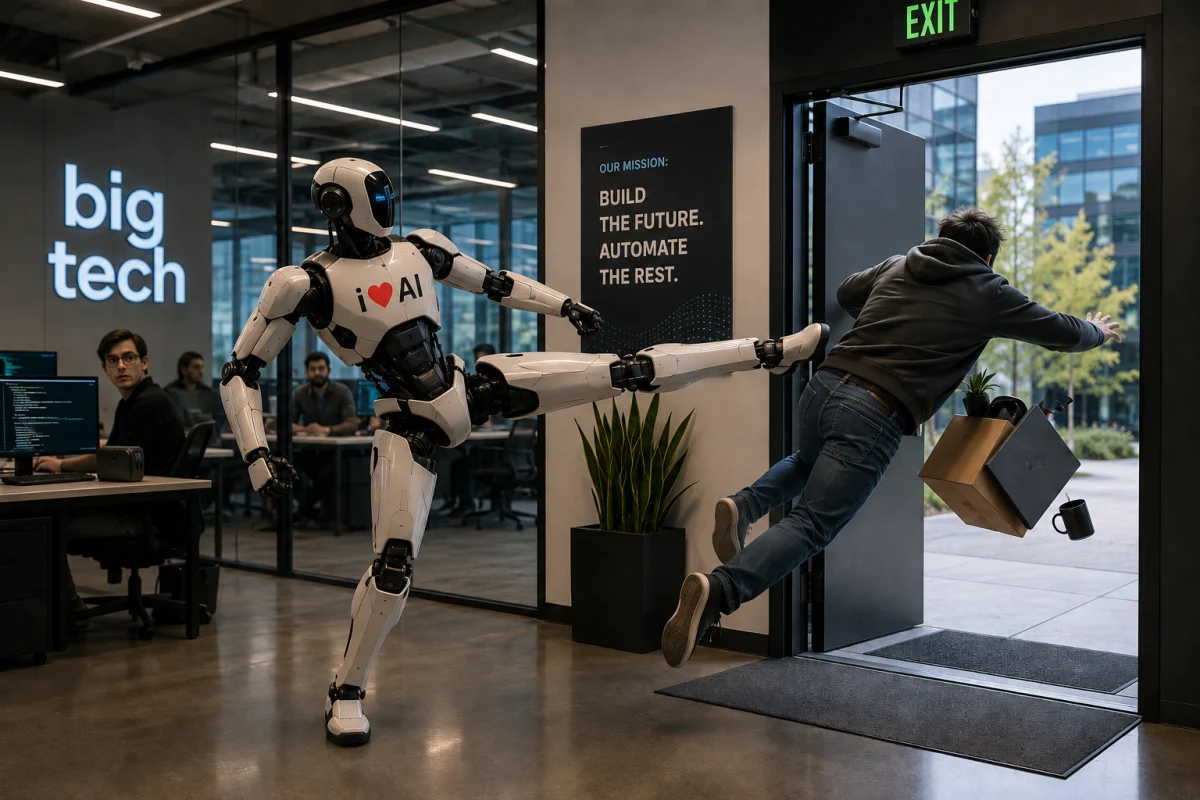
Microsoft, a titan in the technology sector, announced a significant reduction of approximately 4,800 roles, representing 2.1% of its global workforce, marking a prominent instance in a growing trend of artificial intelligence-related layoffs impacting the tech world. While the company stated that these specific positions were not being directly replaced by AI systems, it concurrently acknowledged the profound influence of artificial intelligence in fundamentally altering work processes and automating numerous routine tasks across its operations. This move by Microsoft is indicative of a broader industry-wide re-evaluation of workforce needs and operational strategies in the face of rapidly advancing AI capabilities.
The Dawn of the AI-Driven Workforce Shift
The current wave of layoffs in the tech industry, often juxtaposed with reports of record revenues, has created a sense of unease among employees and observers alike. Companies are increasingly citing AI as both a catalyst for unprecedented growth and a rationale for workforce reductions, presenting a complex narrative of innovation and disruption. Data from outplacement firm Challenger, Gray & Christmas revealed that May of 2026 saw the highest single month of tech layoffs in years, with artificial intelligence being the most frequently cited reason. Cumulatively, approximately 120,000 tech roles have been eliminated in 2026 alone, according to Layoffs.fyi, a platform tracking industry job cuts since 2020.
To understand this phenomenon, it’s crucial to consider the recent trajectory of artificial intelligence. For decades, AI remained largely a theoretical concept or confined to specialized applications. However, the advent of generative AI models in the early 2020s, exemplified by large language models (LLMs) like those powering ChatGPT, dramatically shifted the landscape. These technologies moved from academic research to mainstream corporate tools with unprecedented speed, demonstrating capabilities in content creation, code generation, data analysis, and complex problem-solving that previously required significant human input. This rapid maturation ignited a new AI "gold rush," prompting companies to invest heavily in AI development and integration, viewing it as the next major competitive frontier.
Simultaneously, the tech sector experienced an extraordinary hiring boom during the COVID-19 pandemic. Remote work trends and accelerated digital transformation initiatives led many companies to significantly expand their headcounts, often beyond sustainable levels. As the pandemic receded and economic conditions became more uncertain, a natural correction was anticipated. Artificial intelligence, with its promise of enhanced efficiency and productivity, emerged as a convenient and powerful justification for companies to streamline operations, optimize costs, and reallocate resources towards strategic AI initiatives, often resulting in the displacement of roles that had proliferated during the earlier expansion phase. This confluence of factors has set the stage for the current "AI transformation" impacting global workforces.
A Shifting Employment Landscape
The notion of an "epidemic" of job cuts, even as companies report robust financial health, underscores a significant cultural and social impact within the tech industry. For many employees, the traditional career path in tech, characterized by rapid growth and relative job security, is undergoing a fundamental re-evaluation. The types of roles being affected are varied but often include those involving repetitive tasks, data processing, middle management, and certain customer support functions—areas where AI tools can quickly automate or augment human effort.
This shift necessitates a widespread re-skilling and up-skilling of the workforce. While some roles are being eliminated, others are being created, particularly in areas like AI development, prompt engineering, AI ethics, and data science. However, the pace of job displacement often outstrips the pace of re-skilling, creating a skills gap and exacerbating anxieties about future employment. The cultural impact extends to the psychological contract between employers and employees, with job security becoming a less certain proposition even in high-performing companies. This environment can lead to decreased morale, increased stress, and a more transactional relationship to work.
Corporate Rationales and Financial Realities
Behind the headlines of layoffs, corporate leaders often articulate a consistent set of rationales: the pursuit of "operational efficiency," "organizational simplification," and the imperative to "reallocate resources" towards high-growth areas, primarily artificial intelligence. This narrative frames job reductions not merely as cost-cutting measures but as strategic imperatives to remain competitive in a rapidly evolving technological landscape. For instance, companies often highlight their need to build "high-performing teams that operate with pace and agility," implying that traditional structures or roles are no longer optimal.
The financial underpinnings of these decisions are clear. In many cases, companies are indeed reporting strong revenues and profits. The investment in AI, while substantial, is viewed as a long-term play to unlock new revenue streams, reduce operational costs, and increase shareholder value. By automating tasks and streamlining workflows, businesses aim to achieve more with fewer human resources, leading to improved profit margins and a more agile response to market demands. This creates a paradox where financial success coexists with workforce contraction, raising questions about the distribution of economic benefits from AI advancements. Is the increased productivity translating into broader societal prosperity, or is it concentrating wealth and power within a smaller corporate and executive sphere? Neutral analytical commentary suggests that while efficiency gains are real, the scale of current layoffs also reflects a strategic decision to capitalize on AI as a means to optimize labor costs, potentially independent of immediate financial distress.
Key Players and Their Strategies: A Detailed Overview
The following companies represent a snapshot of major tech firms that have cited AI as a factor in their 2026 workforce adjustments, presented in reverse chronological order:
- Microsoft (July 2026): Announced the elimination of approximately 4,800 roles, or 2.1% of its global workforce. While stating these jobs weren’t directly replaced by AI, the company emphasized that AI is transforming work processes and automating daily tasks, focusing on building agile, high-performing teams. Earlier in April-May 2026, Microsoft also offered voluntary separation packages without disclosing specific numbers, indicating an ongoing effort to streamline operations amid rising AI investments.
- Oracle (June 2026, with cuts ongoing): Disclosed a reduction of 21,000 employees over the preceding 12 months, a 13% decline. The company explicitly stated in a regulatory filing that "the adoption and deployment of AI technologies across our operations have resulted, and may continue to result, in reductions to our workforce." These cuts, which began in March 2026 with "terminal emails," were reportedly aimed at redirecting savings toward AI data centers, despite posting significant quarterly net income growth.
- GitLab (June 2026): Laid off around 350 workers, approximately 14% of its staff, to fund critical AI infrastructure investments and manage surging traffic from AI workloads. CEO Bill Staples spoke of a "generational rebuild" of core infrastructure to support anticipated 100x growth requirements from agentic workloads, alongside exiting 22 countries and flattening management layers.
- Google (Ongoing through May 2026): Alphabet’s Google implemented quiet cuts across its Cloud division, including cybersecurity teams, even as Cloud revenue surged past $20 billion. Over the past year, Google reduced managers overseeing small teams by 35%. The layoffs were a result of rolling performance reviews, voluntary buyouts, and structural reorganizations, with estimates for 2026 ranging from 1,500 to over 3,000 engineers.
- Intuit (May 2026): Announced plans to eliminate roughly 3,000 jobs, about 17% of its total workforce, as part of a restructuring to reduce complexity and reallocate resources towards AI. CEO Sasan Goodarzi communicated that simplifying the organizational structure would enable the delivery of better products.
- Meta (May 2026): Reduced its workforce by approximately 8,000 employees (10%), while simultaneously transitioning about 7,000 employees into new, AI-focused roles. CEO Mark Zuckerberg underscored the necessity of these cuts, stating that "success isn’t a given" in the competitive AI domain.
- Cisco (May 2026): Cut nearly 4,000 jobs, about 5% of its workforce, despite reporting better-than-expected profits and revenues. CFO Mark Patterson clarified that the restructuring was not primarily savings-driven but rather a strategic realignment of resources towards silicon, optics, security, and AI.
- Cloudflare (May 2026): Reduced its workforce by approximately 1,100 people, 20% of its total staff, even as it reported its highest quarterly revenue in company history. CEO Matthew Prince attributed the majority of these layoffs to AI automation, stating that "the vast majority of those we laid off last week were measurers"—referring to roles in middle management, finance, legal, internal auditing, and revenue recognition.
- General Motors (May 2026): Eliminated 500 to 600 jobs, predominantly in IT roles. While citing uncertain market conditions, a person familiar with the situation confirmed that AI played a role in the decision, as the company transforms its IT organization to better position itself for the future, including filling open positions in AI and autonomous vehicles.
- Coinbase (May 2026): The cryptocurrency exchange announced cuts of about 700 employees, 14% of its staff, as part of a restructuring to address market volatility and enhance AI efficiency. The company flattened its organizational structure and indicated it would experiment with "one-person teams," leveraging AI to dramatically accelerate development cycles.
- PayPal (May 2026): Unveiled plans to cut approximately 20% of its workforce—over 4,500 jobs—over the next two to three years. This initiative is central to a turnaround strategy focusing on aggressive AI adoption and organizational simplification. CEO Enrique Lores established a new "AI transformation and simplification" team to redesign processes across all functions, extending AI’s impact beyond coding into areas like customer service and risk management.
- Snap (April 2026): Reduced its global workforce by approximately 1,000 full-time employees, or 16%, and closed over 300 open roles. CEO Evan Spiegel cited rapid advancements in artificial intelligence as a key driver, enabling teams to reduce repetitive work and increase velocity across Snapchat+, ad platforms, and infrastructure.
- IBM (Rolling through 2026): Estimates suggest 3,000 to 9,000 U.S. positions were eliminated through Q4 2025 and April 2026, bringing the cumulative total since September 2024 to over 15,000. While IBM plans to triple entry-level hiring for AI and hybrid-cloud roles, approximately 200 HR positions were reportedly replaced by AI agents, described by the company as routine rebalancing.
- Atlassian (March 2026): Cut about 1,600 jobs, 10% of its workforce, to "rebalance" towards AI and enterprise sales. CEO Mike Cannon-Brookes acknowledged that while their approach isn’t "AI replaces people," it undeniably alters the required mix of skills and the number of roles in certain areas.
- Dell (Disclosed March 2026, cuts from January 2026): Dell’s total workforce decreased by about 10%—roughly 11,000 jobs—in fiscal 2026. The company incurred $569 million in severance costs and projected that its AI-optimized server revenue could double in fiscal 2027, indicating a strategic shift toward AI-centric hardware.
- Block (February 2026): Jack Dorsey’s Block significantly reduced its workforce by 4,000 jobs, nearly half its staff. Dorsey articulated on X that intelligence tools, combined with smaller and flatter teams, were enabling a new operational paradigm, predicting that most companies would adopt similar structural changes within the year.
- Salesforce (February 2026): Laid off fewer than 1,000 employees across various departments, including its Agentforce AI unit. The company stated that the efficiencies provided by Agentforce had reduced the volume of support cases, negating the need to backfill support engineer roles, following earlier cuts of approximately 4,000 customer support positions.
- Amazon (January 2026): Cut 16,000 corporate jobs, following 14,000 cuts in October 2025, representing about 9% of its corporate workforce in three months. CEO Andy Jassy had previously indicated that the widespread adoption of generative AI and agents would lead to a reduction in the total corporate workforce due to efficiency gains.
Broader Societal and Economic Repercussions
The "AI layoff wave" has sparked a critical debate about the future of work and the societal contract. Critics argue that companies reporting record profits while simultaneously cutting jobs, particularly those citing AI, are prioritizing shareholder returns over workforce stability and ethical considerations. This trend could potentially exacerbate income inequality if the benefits of AI-driven productivity gains are not equitably distributed, concentrating wealth in capital-owning entities rather than labor.
From a social perspective, the rapid shifts can erode worker confidence and trust in corporate leadership. The psychological impact on employees, who may perceive their skills as suddenly obsolete, can be profound. This scenario raises urgent questions for policymakers regarding social safety nets, worker retraining programs, and the regulatory oversight of AI’s impact on employment. While some experts predict that AI will ultimately create more jobs than it destroys, the transition period is proving to be highly disruptive, requiring adaptability from both individuals and institutions. The debate between "augmentation" (AI assisting human workers) and "automation" (AI replacing human workers) remains central to understanding the long-term trajectory of this transformation.
Conclusion
The year 2026 stands as a pivotal moment in the ongoing integration of artificial intelligence into the global economy. While AI promises unprecedented innovation, efficiency, and new avenues for growth, its profound impact on employment is undeniable. The wave of layoffs across major tech companies, with AI frequently cited as a primary factor, signals a fundamental reshaping of workforces. This transformation necessitates a proactive approach from companies to manage transitions ethically, from governments to support displaced workers and foster re-skilling, and from individuals to continuously adapt and acquire new competencies. The delicate balance between leveraging AI for progress and mitigating its disruptive social and economic consequences will define this new era.