Amir Mahmud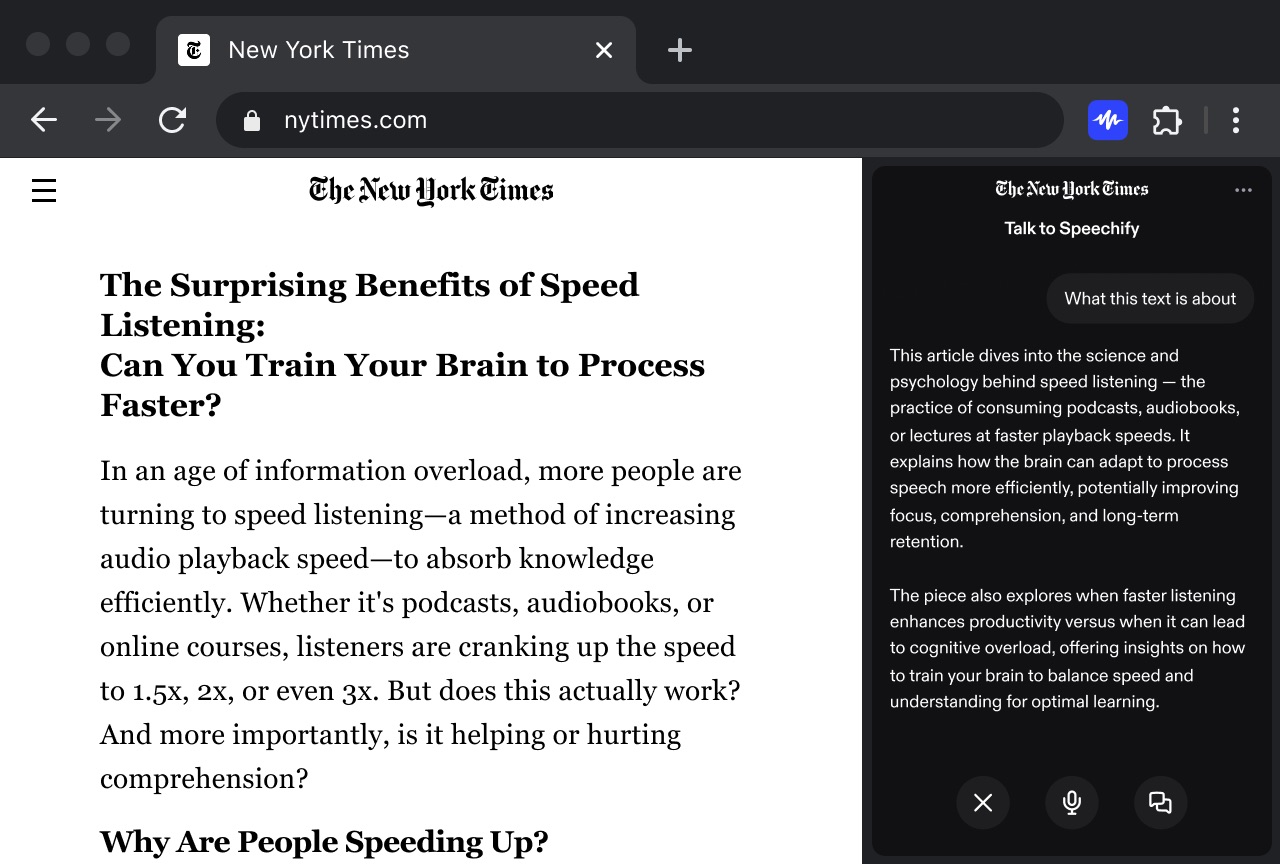
Speechify, a company primarily known for its text-to-speech capabilities, is now significantly expanding its Chrome extension by integrating advanced voice typing and a conversational voice assistant. This strategic pivot signals a broader ambition to move beyond merely converting text to audio, positioning the platform as a comprehensive voice-first productivity tool in an increasingly competitive digital landscape.
The Evolution of Voice AI in Digital Tools
The journey of voice technology in computing is a testament to decades of research and development, evolving from rudimentary speech recognition systems to the sophisticated neural networks powering today’s AI. Early attempts at speech-to-text (STT) in the mid-20th century were often clunky, requiring extensive training and operating with limited vocabularies. The 1990s saw the emergence of commercial dictation software like Dragon NaturallySpeaking, which, while revolutionary for its time, still demanded users to speak deliberately and correct frequent errors.
The last decade, however, has witnessed a monumental leap, largely fueled by advancements in deep learning and the availability of vast datasets. This paradigm shift has enabled speech recognition models to achieve near human-level accuracy in many contexts, making voice interfaces a viable and often preferred mode of interaction. Simultaneously, text-to-speech (TTS) technology has progressed from robotic, synthetic voices to natural-sounding, expressive AI narrators, enhancing accessibility and information consumption.
The widespread adoption of virtual assistants like Apple’s Siri, Amazon’s Alexa, and Google Assistant on mobile devices and smart speakers further normalized voice interaction in daily life. Yet, these assistants often operate within specific ecosystems or as standalone applications, leaving a gap for deeply integrated, context-aware voice tools within web browsers and productivity suites. The recent proliferation of large language models (LLMs) has supercharged this trend, enabling AI to not just understand spoken words but also to comprehend their meaning, generate coherent responses, and even summarize complex information on the fly. This confluence of improved STT, TTS, and LLM capabilities has paved the way for platforms like Speechify to reimagine how users interact with digital content and applications.
Speechify’s New Voice-Centric Offerings
Traditionally, Speechify has served as an invaluable asset for individuals seeking to consume written content auditorily, particularly beneficial for those with learning disabilities, visual impairments, or simply anyone looking to multitask. Its core function involved converting articles, PDFs, and documents into spoken words. The introduction of voice typing and a voice assistant marks a significant expansion, transforming the Chrome extension into a dual-purpose tool for both input and intelligent interaction.
Voice Typing: Enhancing Productivity and Accessibility
The newly launched voice typing feature allows users to dictate text directly into web forms, documents, and email clients. This functionality mirrors other modern dictation tools by actively correcting recognized errors and intelligently filtering out common filler words, aiming for a clean, polished output. For many, this offers a significant boost in productivity, potentially enabling faster content creation than traditional typing, especially for those who can articulate thoughts more quickly than they can type them.
Beyond speed, the implications for accessibility are profound. Individuals with physical disabilities affecting their ability to type, such as repetitive strain injuries or motor impairments, can find a liberating alternative in voice typing. Similarly, for users with dyslexia or other learning differences, verbally expressing ideas can often be a more natural and less taxing process than translating them into written form via a keyboard. This hands-free input method promotes inclusivity, making digital environments more navigable and productive for a broader user base.
However, the initial rollout has encountered some integration challenges. Early user experiences indicate that while the voice typing performs adequately within widely used applications like Gmail and Google Docs, its functionality can be inconsistent on other platforms, such as WordPress. The company acknowledges these limitations, stating that optimizations for popular websites will be rolled out progressively. Furthermore, preliminary assessments suggest that Speechify’s word error rate might be higher compared to some dedicated dictation tools like Wispr Flow, Willow, or Monologue. Speechify’s developers contend that their underlying model is designed to learn and improve rapidly with increased user interaction, promising a gradual decrease in error rates over time. This adaptive learning mechanism is a common characteristic of modern AI systems, where performance often scales with data and usage.
The Conversational AI Assistant: Contextual Intelligence
Complementing the voice typing, Speechify has also introduced a conversational voice assistant, seamlessly integrated into the browser’s sidebar. This assistant is designed to provide context-aware support, allowing users to ask questions directly related to the webpage they are currently viewing. Imagine browsing a lengthy research paper and simply asking, "What are the three key ideas?" or encountering complex terminology and requesting, "Explain this in simpler terms." Such capabilities promise to streamline information processing and learning, making web content more digestible and interactive.
This feature leverages the power of advanced natural language processing (NLP) to understand queries and extract relevant information from the displayed content. Its primary appeal lies in its immediacy and contextual relevance, offering on-demand insights without requiring users to navigate away from their current page.
Speechify aims to differentiate its voice assistant from the conversational modes offered by general-purpose AI platforms like ChatGPT and Google Gemini. While these platforms do support voice interaction, Speechify’s Chief Business Officer, Rohan Pavuluri, highlights a fundamental difference in design philosophy. According to Pavuluri, voice in ChatGPT and Gemini often remains a secondary, "afterthought" mode of interaction, with chat being the default user experience. Speechify, in contrast, is committed to a "voice-first" approach, where auditory interaction is the primary and default setting. This strategic emphasis targets a segment of the market that explicitly prefers speaking to AI over typing, potentially fostering a more intuitive and natural user experience for that demographic.
A current technical constraint is the assistant’s incompatibility with browsers that already feature their own built-in sidebar assistants, such as OpenAI’s Atlas, Perplexity’s Comet, or Dia. However, Speechify appears unconcerned by this, given its primary focus on Chrome and its massive global user base, which remains largely unaffected by these niche browser integrations.
Navigating the Competitive Landscape
The market for voice AI tools is vibrant and highly competitive, populated by both tech giants and nimble startups. Google’s Chrome itself offers integrated voice typing, and its broader AI ecosystem, including Google Assistant and Gemini, provides powerful voice capabilities. Microsoft, Apple, and Amazon also invest heavily in their respective voice AI platforms.
Speechify’s strategy appears to be one of deep integration and specialized focus. By embedding comprehensive voice features directly into the Chrome extension, it aims to become an indispensable tool for browser-based productivity. Its "voice-first" philosophy is a deliberate attempt to carve out a niche against the multi-modal giants, appealing to users who specifically seek an auditory-centric digital experience. The success of this approach will hinge on superior performance, seamless integration, and a user experience that genuinely feels more natural and efficient than its text-based or multi-modal alternatives.
Initial Impressions and Future Optimizations
The initial user feedback, as highlighted in testing, underscores the typical challenges faced by new AI product launches: the gap between theoretical potential and real-world, consistent performance. The observed difficulties in triggering dictation on certain sites and a higher word error rate compared to some established competitors suggest that while the foundation is promising, refinement is crucial.
Speechify’s commitment to continuous optimization, particularly its claim that the AI model learns and improves with usage, is a key factor to watch. This iterative development process, common in AI, means that early limitations might not reflect the long-term capabilities of the tool. The gradual rollout of site-specific optimizations will also be critical in addressing compatibility issues and ensuring a smooth user experience across the web.
Beyond Dictation: The Vision for Autonomous AI Agents
Looking ahead, Speechify’s ambitions extend beyond enhancing current voice interactions. The company is actively exploring the development of "agents" capable of completing tasks autonomously on behalf of the user. This vision taps into a broader trend in AI development, where intelligent systems are designed not just to answer questions or transcribe speech but to execute complex sequences of actions.
While the full roadmap remains under wraps, an illustrative example provided is the ability for an AI agent to make calls to schedule appointments or even wait on hold with customer support. Such capabilities would represent a significant leap in automation, freeing users from tedious, time-consuming tasks. The concept of AI agents acting as personal digital assistants, handling administrative chores and proactive communication, holds immense potential for transforming personal and professional productivity. This frontier is also being explored by other innovators, with companies like Truecaller partnering with Microsoft for AI-powered call responses and Cloaked developing AI for caller screening. The ethical implications and user trust associated with such autonomous agents, particularly concerning privacy and decision-making, will undoubtedly be central to their successful integration into daily life.
Broader Market Implications and User Experience
The integration of advanced voice typing and a contextual assistant by Speechify represents more than just new features; it reflects a broader cultural and technological shift towards more natural, intuitive human-computer interaction. As screens proliferate and information overload intensifies, voice offers a hands-free, eyes-free alternative for interaction, aligning with demands for greater efficiency and accessibility.
The success of Speechify’s expanded offerings will depend on several factors: the speed at which its AI models improve, the seamlessness of its integration across diverse web environments, and its ability to build user trust. If these tools consistently deliver on their promise of accuracy and utility, they could significantly alter daily digital workflows, empowering users to interact with information and generate content in ways previously confined to science fiction. The move by Speechify underscores the ongoing race among technology companies to redefine the boundaries of what voice AI can achieve, making digital experiences more intuitive, productive, and accessible for everyone.