Amir Mahmud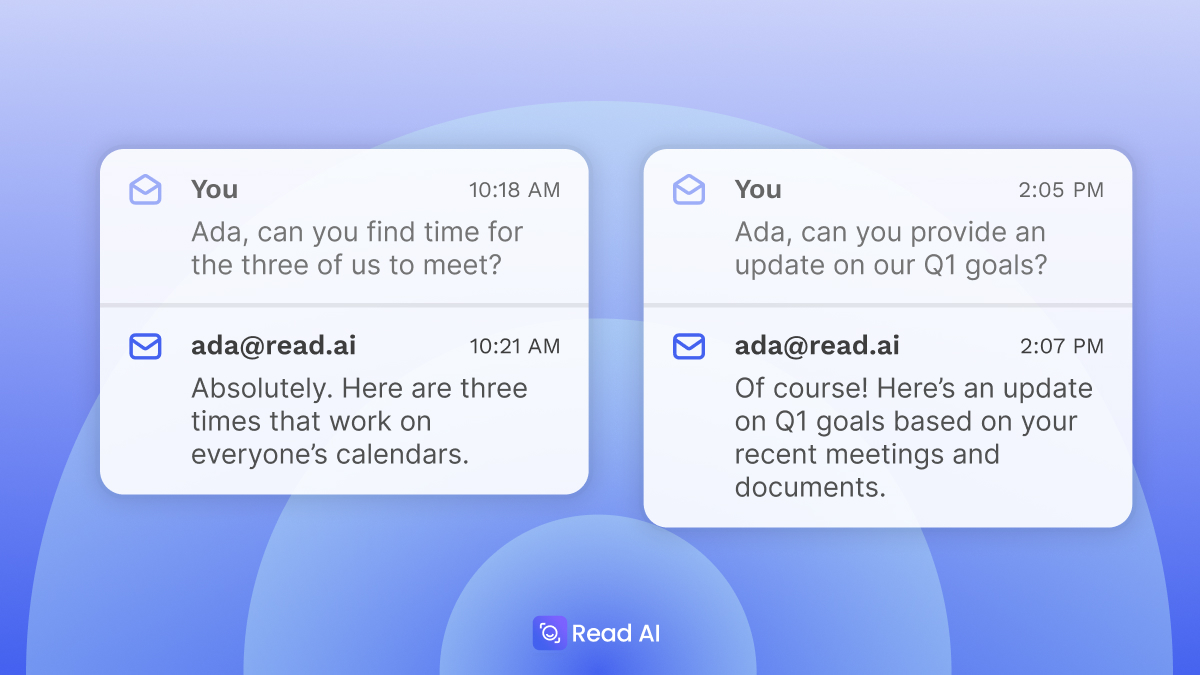
Read AI, a company known for its meeting summarization technology, has introduced an innovative artificial intelligence-powered assistant named Ada. This new offering aims to significantly enhance professional productivity by automating various email-based tasks, including schedule management, information retrieval from organizational knowledge bases, and crafting responses to out-of-office inquiries. Positioned as a "digital twin," Ada is designed to operate autonomously, providing round-the-clock support to users. The service is now accessible to all Read AI users, who can initiate its setup by sending an email to "ada@read.ai" with the subject "Get me started."
The Dawn of the Digital Twin in the Workplace
The concept of a "digital twin" has traditionally been applied in industrial settings, representing a virtual replica of a physical object or system. In the context of Ada, Read AI is extending this metaphor to personal productivity, envisioning an AI entity that mirrors and extends a user’s professional capabilities. This digital counterpart is engineered to manage a spectrum of tasks, acting as a proactive proxy in email communications. By handling routine yet time-consuming administrative functions, Ada seeks to free up human users to concentrate on more complex, strategic work.
One of Ada’s primary functionalities revolves around meeting coordination. When tasked with arranging a meeting, the AI assistant intelligently accesses the user’s calendar via Read AI’s existing integrations. It then communicates directly with other participants in the email thread, proposing available time slots. Crucially, Ada is designed to maintain privacy, never disclosing the specific nature or titles of existing calendar entries to external parties. If initial suggestions don’t align with the other person’s availability, Ada can iteratively propose new options, streamlining a process that often involves multiple back-and-forth emails. This automated negotiation significantly reduces the overhead associated with scheduling, a common pain point in professional environments.
Beyond scheduling, Ada demonstrates robust information retrieval capabilities. It can synthesize data from a company’s internal knowledge base, glean insights from previous meeting discussions, and even conduct public internet searches to answer specific queries. For instance, a user could ask, "Ada, can you provide an update on how we are tracking for Q1 goals?" and receive a compiled response. Furthermore, if a question arises within an email thread, Ada can draft a preliminary response for the user’s review and refinement before it is dispatched. The startup emphasizes that Ada operates under strict permission protocols, ensuring no sensitive information is shared without explicit user authorization, addressing critical concerns around data security and privacy.
The Technical Backbone: Knowledge Graphs and Contextual AI
Justin Farris, VP of Product at Read AI, shed light on the sophisticated architecture underpinning Ada. He explained that the new feature does not rely on Model Context Protocols (MCPs), a technical standard for connecting AI tools to external services. Instead, Ada constructs a comprehensive "knowledge graph." This graph is dynamically built from an array of data sources, including meeting transcripts, connected services, and other contextual information, enabling Ada to generate highly relevant and nuanced answers. This approach allows for a deeper understanding of user intent and organizational context, moving beyond superficial information retrieval to more intelligent, context-aware assistance.
Farris also hinted at the future trajectory of Ada, indicating that the assistant will progressively evolve to take more proactive actions. An example provided was Ada identifying a follow-up item mentioned during a meeting and subsequently prompting the user to set it up, complete with relevant contextual data. This move towards proactive engagement signifies a shift from reactive assistance to an anticipatory digital partner, further blurring the lines between human and AI-driven task management. David Shim, CEO of Read AI, drew an analogy, stating, "The way I describe our solution is that when you are bringing on a new employee, you train them. When you add Ada to your workflow and connect more services to give more context, it starts to ramp up and handle more tasks for you." This perspective underscores the adaptive and learning nature of Ada, implying that its utility will grow proportionally with its exposure to a user’s workflow and data ecosystem.
Evolution of Workplace Productivity: A Historical Perspective
The introduction of Ada is not an isolated event but rather a significant step in the ongoing evolution of workplace productivity tools. For decades, businesses have sought ways to optimize employee output and streamline operations. The journey began with rudimentary office automation in the mid-20th century, evolving through the widespread adoption of email in the 1990s and the proliferation of calendar and project management software in the 2000s. The advent of cloud computing and mobile technologies further accelerated this trend, making collaboration and data access more ubiquitous.
The past few years have witnessed an unprecedented surge in AI integration into these tools. Initial applications often focused on passive assistance, such as AI-powered meeting notetakers and transcription services, like Read AI’s foundational offering. These tools aimed to capture information, summarize discussions, and identify action items, thereby reducing the manual effort of post-meeting documentation. Ada represents a crucial pivot, transitioning from passive observation and summarization to active, autonomous participation in daily workflows. This shift reflects a broader industry trend towards intelligent automation that not only assists but actively performs tasks, transforming how professionals interact with their digital environments.
The Competitive Landscape and Market Dynamics
The market for AI-powered productivity solutions is becoming increasingly crowded and innovative. Read AI, with its initial focus on meeting summaries, has carved out a niche, but other players are also pushing the boundaries. Companies like Granola, for instance, have introduced "recipes" in the form of repeatable prompts to extract specific knowledge from meeting data. Similarly, Quill, a recent entrant that emerged from stealth with substantial funding, aims to automate tasks by connecting to various tools such as Linear, Notion, and Customer Relationship Management (CRM) systems.
Ada differentiates itself by embedding AI directly into the email communication layer, a ubiquitous and often overwhelming aspect of professional life. While other tools focus on optimizing data after it’s been generated in meetings or other platforms, Ada actively participates in the generation and management of communications and schedules. This proactive, email-centric approach positions Ada as a front-line assistant, intercepting and managing tasks at the point of origin, rather than merely processing outcomes. This strategic focus on email—a channel often cited as a major source of digital overload—could provide Read AI with a significant competitive advantage by tackling a fundamental productivity bottleneck.
Societal and Cultural Implications of AI Assistants
The rise of AI assistants like Ada carries significant social and cultural implications for the modern workforce. On one hand, these tools promise to liberate professionals from repetitive, low-value administrative tasks, allowing them to redirect their energy towards more creative, analytical, and strategic endeavors. This could lead to increased job satisfaction, reduced burnout, and a more fulfilling work experience. The ability to offload scheduling negotiations, routine email responses, and information retrieval to an AI "digital twin" could genuinely transform daily work patterns, making individuals and teams more efficient and agile.
However, the widespread adoption of such AI assistants also raises pertinent questions. The potential for an "always-on" work culture could intensify, as AI assistants operate 24/7, potentially blurring the lines between work and personal life even further. Concerns about data privacy and security are paramount, especially as these systems gain access to sensitive calendar details, meeting discussions, and internal knowledge bases. While Read AI emphasizes permission-based sharing, the sheer volume and sensitivity of data processed by such an AI necessitate robust security protocols and transparent privacy policies.
Furthermore, there is a broader discussion about the evolving nature of human skills. As AI takes over more routine communication tasks, will certain human aptitudes, such as meticulous scheduling or nuanced email etiquette, diminish? The emphasis will increasingly shift towards higher-order skills like critical thinking, emotional intelligence, complex problem-solving, and effective collaboration with AI systems. The "human touch" in communication, particularly in sensitive or high-stakes interactions, remains invaluable, and the challenge for AI assistants will be to augment, rather than replace, this essential human element.
Read AI’s Ambitious Growth and Future Outlook
Read AI is not just launching a new product; it is executing an ambitious growth strategy. The company has successfully raised over $81 million in funding, indicating strong investor confidence in its vision and technology. Its existing suite of AI-powered tools already includes "Search Copilot" for knowledge discovery and capabilities to update customer-service relationship software, send custom emails from meeting reports, and stay updated on topics based on internal and web knowledge. These integrations demonstrate a holistic approach to embedding AI across various professional workflows.
The company’s user base metrics underscore its rapid expansion. CEO David Shim revealed at Web Summit Qatar that Read AI currently boasts over 5 million monthly active users, with an ambitious target to grow that number to 10 million. The platform sees approximately 50,000 new sign-ups daily, and an additional 100,000 users consume Read AI’s content, such as meeting summaries, without necessarily creating an account. While the United States remains its largest market, Read AI is experiencing robust international growth, with 60% of its users located outside the U.S., even as revenue generation is roughly split equally between domestic and international markets.
Looking ahead, Read AI plans to extend Ada’s reach beyond email. The company has stated that the AI assistant will soon be available on popular collaboration platforms like Slack and Teams, further embedding its capabilities into the daily fabric of enterprise communication. This multi-platform strategy indicates a clear intent to make Ada an omnipresent, indispensable assistant across diverse digital workspaces.
In conclusion, Read AI’s Ada represents a significant leap forward in the application of artificial intelligence to personal and professional productivity. By automating email-centric tasks, managing schedules, and facilitating information access, Ada promises to redefine efficiency in the modern workplace. While presenting exciting opportunities for enhanced productivity and job enrichment, its deployment also necessitates careful consideration of data privacy, security, and the evolving dynamics of human-AI collaboration. As AI continues to mature, solutions like Ada will undoubtedly play a pivotal role in shaping the future of work.