Azin Asro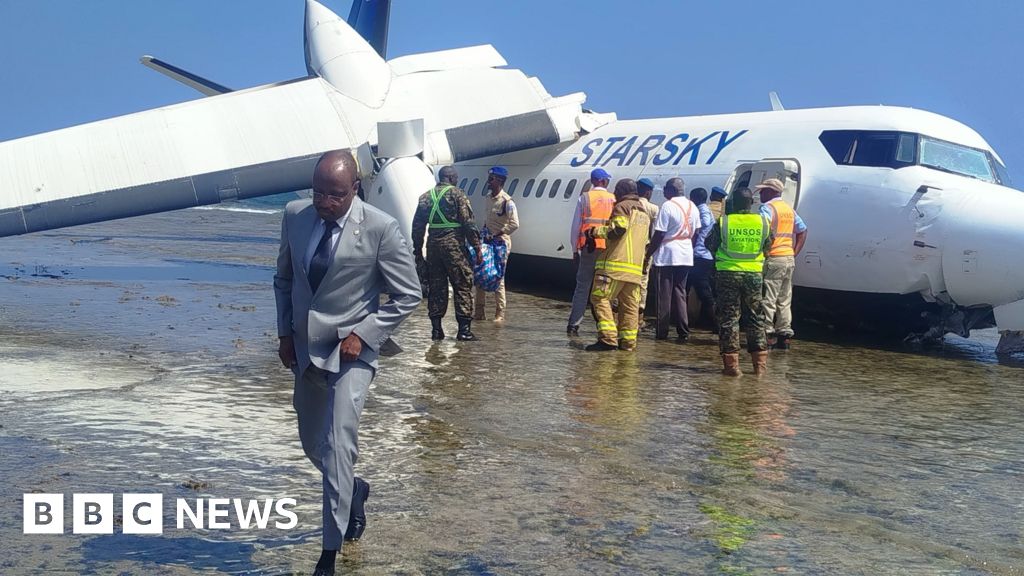
Aviation professionals and the broader public are commending the exceptional skill and quick thinking of a pilot who successfully executed an emergency landing of a passenger aircraft on the shoreline adjacent to Mogadishu’s international airport, ensuring the survival of all 55 individuals on board. The incident, which occurred on Tuesday, saw a Starsky Aviation Fokker 50 aircraft experience a significant technical malfunction shortly after departing from Aden Adde International Airport, prompting the crew to request an immediate return. Despite the critical situation, the pilot managed to bring the plane down, ultimately coming to rest in shallow coastal waters after overshooting the runway. This remarkable outcome underscores the crucial role of pilot training, experience, and calm decision-making in averting what could have been a catastrophic event.
The Harrowing Descent
The flight, carrying 50 passengers and five crew members, was en route from Somalia’s capital, Mogadishu, to Puntland, a semi-autonomous region in the country’s northeast. Moments after takeoff, an unspecified technical issue arose, triggering emergency protocols. The crew promptly communicated their distress and requested clearance to return to Aden Adde International Airport. Air traffic control swiftly granted the request, initiating emergency response procedures on the ground. However, the severity of the malfunction became apparent as the aircraft approached the runway for landing.
Eyewitnesses described a tense atmosphere as the plane descended, its landing not unfolding as typical. Instead of coming to a controlled stop on the tarmac, the aircraft continued its momentum, failing to decelerate sufficiently. It ultimately overran the designated landing strip, skidding across the terrain before plunging into the Indian Ocean’s shallow coastal waters. Images from the scene depicted the plane partially submerged, its right wing visibly damaged, a stark testament to the forces at play during the uncontrolled stop. The immediate deployment of rescue teams, including personnel from the African Union Transition Mission in Somalia (ATMIS) and United Nations forces, was pivotal in ensuring the swift and safe evacuation of everyone from the compromised aircraft. Somalia’s Minister of Transport and Civil Aviation also arrived at the scene to oversee the response efforts, highlighting the high-level concern and relief following the successful evacuation.
A Pilot’s Decisive Actions
Starsky Aviation, the operator of the aircraft, was quick to laud the pilot’s actions, attributing the survival of all on board to their "swift and calm decision-making." Hassan Mohamed Aden, a spokesperson for the airline, emphasized that the pilot’s ability to maintain control and guide the aircraft to a relatively safe landing spot, despite the malfunction and the runway overrun, was instrumental. This sentiment is echoed by aviation experts who often highlight the immense pressure pilots face in such scenarios, where seconds can mean the difference between life and death.
Pilots undergo rigorous training that includes extensive simulations of various emergency situations, from engine failures to landing gear malfunctions. The ability to apply these learned procedures under real-world stress, coupled with an intuitive understanding of aircraft dynamics and environmental factors, defines true professionalism. In this instance, the pilot’s decision to attempt a landing back at the airport, rather than an uncontrolled descent elsewhere, and then to navigate the aircraft towards the relatively forgiving shoreline, demonstrated an acute awareness of available options and their potential outcomes. An uncontrolled landing on land could have resulted in a far more destructive impact, whereas the shallow water provided a cushioning effect, absorbing some of the kinetic energy and preventing a more catastrophic breakup of the fuselage. This type of controlled, yet unplanned, water landing is often referred to as a ditching or a "water landing," and its successful execution with no fatalities is rare and highly commendable.
The Fokker 50: A Workhorse of Regional Skies
The aircraft involved in the incident was a Fokker 50, a twin-turboprop airliner developed by the Dutch manufacturer Fokker. First introduced in the mid-1980s, the Fokker 50 was designed as an improved and more fuel-efficient successor to the highly successful Fokker F27 Friendship. It has earned a reputation as a robust and reliable aircraft, particularly well-suited for short-haul regional flights and operations in challenging environments, thanks to its durable construction and ability to operate from shorter, less-developed runways.
Globally, the Fokker 50 has served numerous airlines, particularly in regions where airport infrastructure might be less advanced. Its operational history includes extensive service in Africa, Asia, and Europe, flying a diverse range of routes, from commercial passenger services to cargo and even military transport roles. While specific details of the technical fault on the Starsky Aviation flight remain under investigation, the incident will undoubtedly lead to a thorough examination of the aircraft’s maintenance records, operational history, and the nature of the malfunction. Aviation safety protocols mandate that such incidents, regardless of their outcome, trigger comprehensive inquiries to identify root causes and implement corrective measures to prevent future occurrences.
Somalia’s Aviation Landscape
The incident also sheds light on the broader context of Somalia’s aviation sector. For decades, Somalia has grappled with internal conflict, political instability, and underdeveloped infrastructure. The civil aviation industry has faced immense challenges, including maintaining safety standards, investing in modern equipment, and ensuring robust regulatory oversight. Despite these hurdles, air travel remains a critical mode of transport within Somalia and for connecting the nation to the wider world. Given the difficulties and security risks associated with land travel in many parts of the country, air routes provide essential links for business, government, humanitarian aid, and personal travel.
Aden Adde International Airport (MGQ) in Mogadishu has been a focal point of efforts to rebuild and modernize Somalia’s infrastructure. Over the past decade, with support from international partners, the airport has seen significant upgrades to its facilities, including runways, air traffic control systems, and terminal buildings. These improvements are crucial for enhancing safety, increasing capacity, and attracting more international carriers, thereby fostering economic growth and greater connectivity. However, incidents like the recent emergency landing underscore the ongoing need for vigilance, continuous investment in maintenance, and strict adherence to international aviation safety standards. The Somali Civil Aviation Authority (CAA), which oversees the nation’s air space and aviation operations, plays a vital role in regulating airlines and investigating incidents, working towards aligning local practices with global best practices.
The Aftermath and Ongoing Investigation
Following the successful evacuation, the immediate priority shifted to securing the accident site and initiating a formal investigation. The Somali Civil Aviation Authority (CAA) confirmed that an inquiry is underway to ascertain the exact cause of the technical issue that precipitated the emergency landing. Such investigations typically involve a multi-faceted approach, examining flight data recorders ("black boxes"), cockpit voice recorders, aircraft maintenance logs, pilot testimonies, and environmental factors. International aviation bodies may also offer assistance, particularly given the specialized nature of accident investigation.
The long-term implications for Starsky Aviation will depend on the findings of the investigation. Airlines are heavily scrutinized after such events, with passenger confidence and operational licenses often at stake. A thorough and transparent investigation is crucial not only for determining liability but also for restoring public trust and implementing necessary safety enhancements across the fleet. The damaged Fokker 50 will likely be written off, representing a significant financial loss for the airline, although insurance will mitigate some of this impact. Beyond the immediate financial and logistical challenges, the incident serves as a stark reminder of the inherent risks in air travel and the absolute necessity of rigorous safety protocols and highly trained personnel.
Broader Implications for Air Travel Safety
This incident, while unique in its specifics, resonates with broader discussions about aviation safety worldwide, particularly in developing regions. While global air travel has become remarkably safe over the decades, isolated incidents highlight the importance of continuous improvement in aircraft design, maintenance practices, and pilot training. For countries like Somalia, which are rebuilding their national institutions and infrastructure, ensuring that civil aviation keeps pace with international safety benchmarks is a monumental task. It requires consistent investment in technology, human resources, and robust regulatory frameworks.
The survival of all 55 individuals on the Starsky Aviation flight stands as a testament to human resilience and the efficacy of emergency procedures when expertly executed. It is a story of a pilot’s profound courage and skill, transforming a potentially tragic failure into a remarkable rescue. As investigations proceed, the aviation community will undoubtedly learn valuable lessons from this event, reinforcing the collective commitment to making air travel as safe as possible, even in the most challenging operational environments. The incident serves as a powerful reminder that while technology plays a significant role in modern aviation, the human element—the judgment, training, and bravery of the flight crew—remains an irreplaceable cornerstone of air safety.







 Amir Mahmud