Amir Mahmud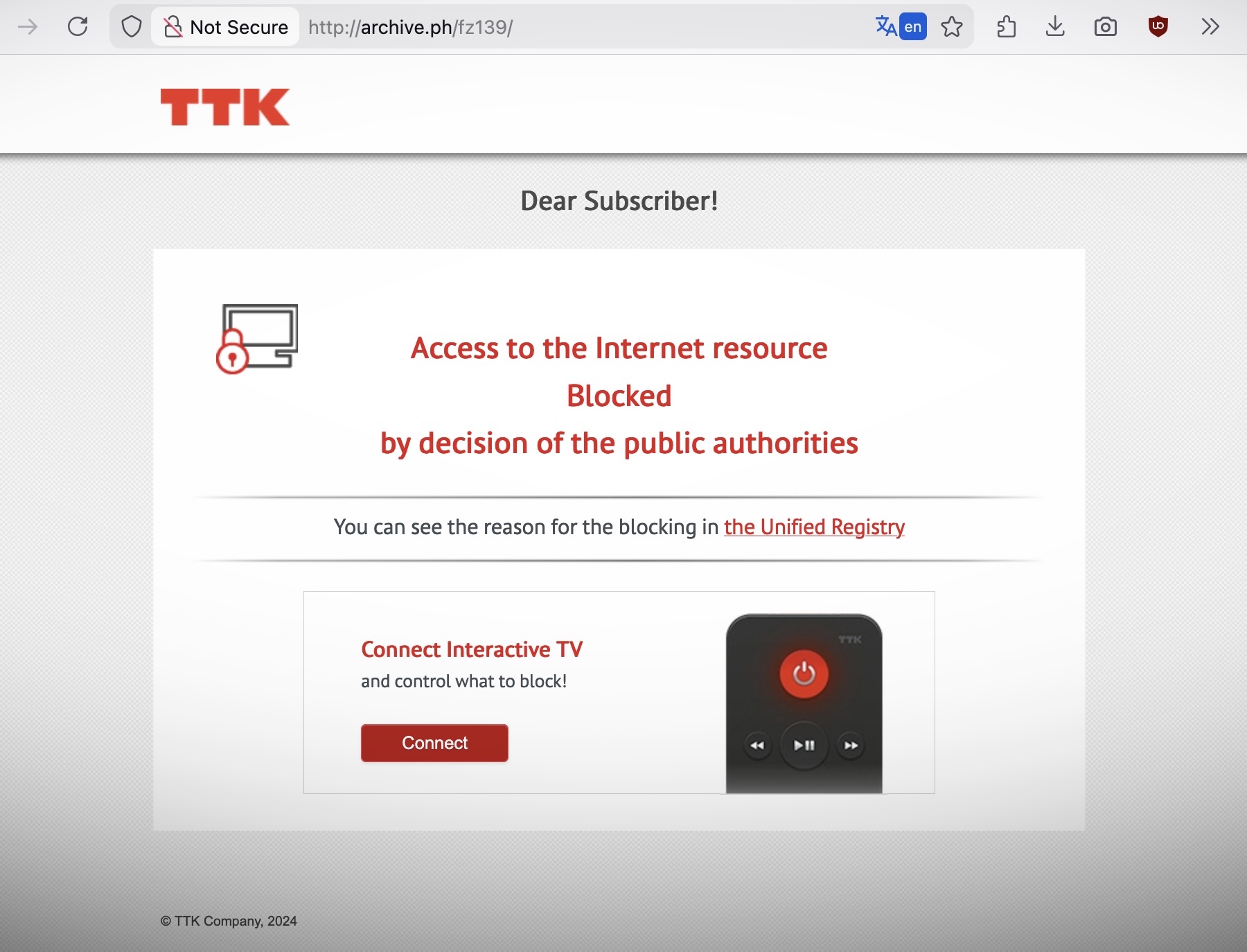
Russian authorities have initiated a widespread block against the popular web archiving service Archive.today and several of its associated domains, including Archive.is and Archive.ph. The measure, observed as of Monday, March 23, 2026, has rendered these platforms inaccessible to users within Russia, signaling an escalation in the state’s ongoing efforts to control online information. Attempts to access the websites from various locations in the U.S. East Coast revealed error messages, explicitly attributing the block to decisions made by public authorities.
Initial Blocking and Official Response
Upon attempting to load Archive.is, users were met with a message in Russian stating, "Access to the Internet resource Blocked by decision of the public authorities." This notification typically indicates action taken by Roskomnadzor, Russia’s federal agency responsible for overseeing media and internet censorship. While Roskomnadzor’s official registry confirmed that "access is limited to the page" for Archive.is, the agency did not provide an immediate public explanation for the comprehensive block at the time of publication. A representative for Roskomnadzor was unavailable for comment outside Moscow’s working hours. The full scope and technical implementation of the block remain somewhat ambiguous, though the initial observations suggest a significant disruption to access across multiple related domains.
Understanding Archive.today: A Digital Preservation Tool
Archive.today, often interchangeably referred to as Archive.is, operates as a non-profit web archiving service that allows users to create on-demand snapshots of web pages. These static copies serve multiple critical functions: they preserve ephemeral online content, offer a means to bypass soft paywalls or subscription prompts for specific articles, and provide an immutable record of information that might otherwise be altered or removed from the live internet. For journalists, researchers, fact-checkers, and human rights activists globally, such services are invaluable. They enable the verification of claims, documentation of events, and the ability to cite sources even if the original content disappears or changes. Unlike the Internet Archive’s Wayback Machine, which crawls the web systematically, Archive.today primarily relies on user-initiated requests to archive specific pages, making it a reactive tool for preserving content of immediate interest. This functionality has positioned it as a crucial component of digital memory, helping to maintain accountability and transparency in an increasingly volatile online environment.
Russia’s Expanding Digital Control Apparatus
The blocking of Archive.today is not an isolated incident but rather fits within a broader, decades-long trajectory of increasing state control over the internet in Russia. Initially, internet regulation focused on specific categories like child pornography, drug-related content, or extremist materials. However, in the mid-2010s, and particularly after 2014, the scope of what constitutes "undesirable" content expanded dramatically. Laws targeting "fake news," discrediting the armed forces, and promoting "unauthorized protests" have empowered authorities to swiftly block websites and online services.
A pivotal moment came with the "Sovereign Internet Law," enacted in 2019. This legislation aimed to create a robust, independent Russian internet infrastructure, theoretically capable of operating in isolation from the global network if necessary. While proponents argued it was a national security measure against cyber threats, critics widely viewed it as a tool for enhanced censorship and surveillance. This law granted Roskomnadzor unprecedented powers, including the ability to centralize control over internet traffic routing and deep packet inspection (DPI) technologies, which allow for granular filtering of content. The implementation of DPI has made it possible for authorities to block specific websites, applications, and even VPN services with greater precision and effectiveness than ever before.
The Role of Roskomnadzor in Internet Censorship
Roskomnadzor stands at the forefront of Russia’s internet censorship efforts. Established in 2008, its mandate has progressively broadened from media oversight to becoming the principal enforcer of online content restrictions. The agency maintains various blacklists of prohibited websites, often acting on directives from other government bodies, courts, or even individual complaints. Reasons for blocking can range from content deemed extremist or promoting illegal activities to information considered to be discrediting the state or its policies.
The process often lacks transparency. Websites can be blocked without prior notice, and the specific justification may not be immediately clear or publicly disclosed. This opaque system creates an environment of uncertainty for online service providers and users alike, fostering self-censorship and limiting access to diverse information. Roskomnadzor’s actions against major foreign tech companies, including social media platforms and news outlets, have become increasingly frequent, underscoring the agency’s resolve to shape the information landscape within Russia’s digital borders. The blocking of a tool like Archive.today, which fundamentally undermines attempts to erase or control narratives by preserving them, represents a logical, albeit significant, step in this ongoing campaign.
Implications for Information Access and Digital Memory
The move to block Archive.today carries profound implications for information access, freedom of expression, and the concept of digital memory within Russia. By targeting a service that preserves web content, authorities are not merely preventing access to current "undesirable" information but also attempting to erase the historical record of online discourse. This creates a challenging environment for accountability, as it becomes harder to verify past statements, track policy changes, or document human rights abuses when the original sources are either removed or rendered inaccessible.
For journalists and researchers operating within or focusing on Russia, Archive.today has been a vital resource. Its ability to capture snapshots of rapidly changing or disappearing web pages ensures that critical evidence and context are not lost. The block impedes their capacity to conduct independent investigations, fact-check official narratives, and report accurately on events, especially when original sources might be intentionally taken down. Furthermore, the paywall bypass feature, while a point of contention for publishers, offered a route for ordinary citizens to access independent news and analysis that might otherwise be behind a subscription barrier. In a media landscape increasingly dominated by state-controlled outlets, this function was particularly significant for accessing alternative perspectives. The blocking thus contributes to an information vacuum, making it more difficult for Russian citizens to form informed opinions based on a wide range of sources.
Recent Controversies Clouding Archive.today’s Reputation
Adding a layer of complexity to the narrative surrounding Archive.today is a recent controversy involving the service’s alleged operational practices. Just prior to the Russian block, in February 2026, Wikipedia editors made a significant decision to remove hundreds of thousands of links to Archive.today. The move stemmed from allegations that Archive.today’s underlying code was being utilized to commandeer visitors’ web browsers, without their explicit consent or knowledge, to generate junk network traffic. This traffic was reportedly directed at the website of a blogger who had been critical of Archive.today’s operations, effectively launching a distributed denial-of-service (DDoS) attack.
This incident raised serious ethical questions about Archive.today’s conduct and its commitment to user privacy and internet etiquette. While the alleged DDoS activity is distinct from the motivations behind the Russian government’s block, it undoubtedly cast a shadow over the service’s reputation among some segments of the internet community. The Wikipedia decision highlighted concerns about the trustworthiness of a platform whose core function is information preservation, yet which was accused of engaging in potentially malicious behavior. This controversy, irrespective of its connection to the Russian state’s actions, serves as an important backdrop to the ongoing discussion about the reliability and ethics of web archiving services. Archive.today operators did not publicly respond to requests for comment regarding either the alleged DDoS activities or the recent Russian block.
The Broader Impact on Russian Internet Users
The blocking of Archive.today represents another erosion of digital freedoms for internet users in Russia. It forces those seeking information beyond state-sanctioned channels to resort to more sophisticated circumvention tools like Virtual Private Networks (VPNs) and proxy servers. However, the Russian government has also intensified its efforts to block or degrade the performance of these tools, creating a continuous cat-and-mouse game between authorities and users. This dynamic contributes to the fragmentation of the global internet, often referred to as the "splinternet," where different nations operate increasingly distinct and controlled online environments.
Culturally and socially, such blocks contribute to a sense of digital isolation and reinforce the narrative promoted by the state. When access to diverse perspectives and historical records is curtailed, it becomes challenging for citizens to engage in critical discourse or access information that might contradict official pronouncements. This can lead to a more homogenous information diet, potentially impacting civic engagement and the ability to hold power accountable. The long-term consequences could include a decline in media literacy and an increased reliance on information from official sources, further solidifying state control over public perception.
Looking Ahead: The Future of Digital Freedom in Russia
The blocking of Archive.today underscores the Russian government’s unwavering commitment to establishing a tightly controlled national information space. This action, coupled with previous measures against social media platforms, independent news outlets, and VPN services, paints a clear picture of a deliberate strategy to limit access to information deemed undesirable or destabilizing. While the immediate reason for targeting Archive.today remains officially unstated, its role in preserving potentially inconvenient historical data and bypassing access restrictions likely made it an inevitable target in the broader campaign for information dominance.
The incident serves as a stark reminder of the ongoing global struggle between state efforts to control information and the inherent desire for open access and digital freedom. For users within Russia, the future likely involves a continued reliance on increasingly sophisticated, and often more risky, methods of circumvention. For the international community, it highlights the growing challenge of maintaining an open and accessible internet in the face of assertive national censorship regimes. The digital landscape in Russia continues to evolve, characterized by an escalating technological arms race between state control and the persistent pursuit of information access.