Amir Mahmud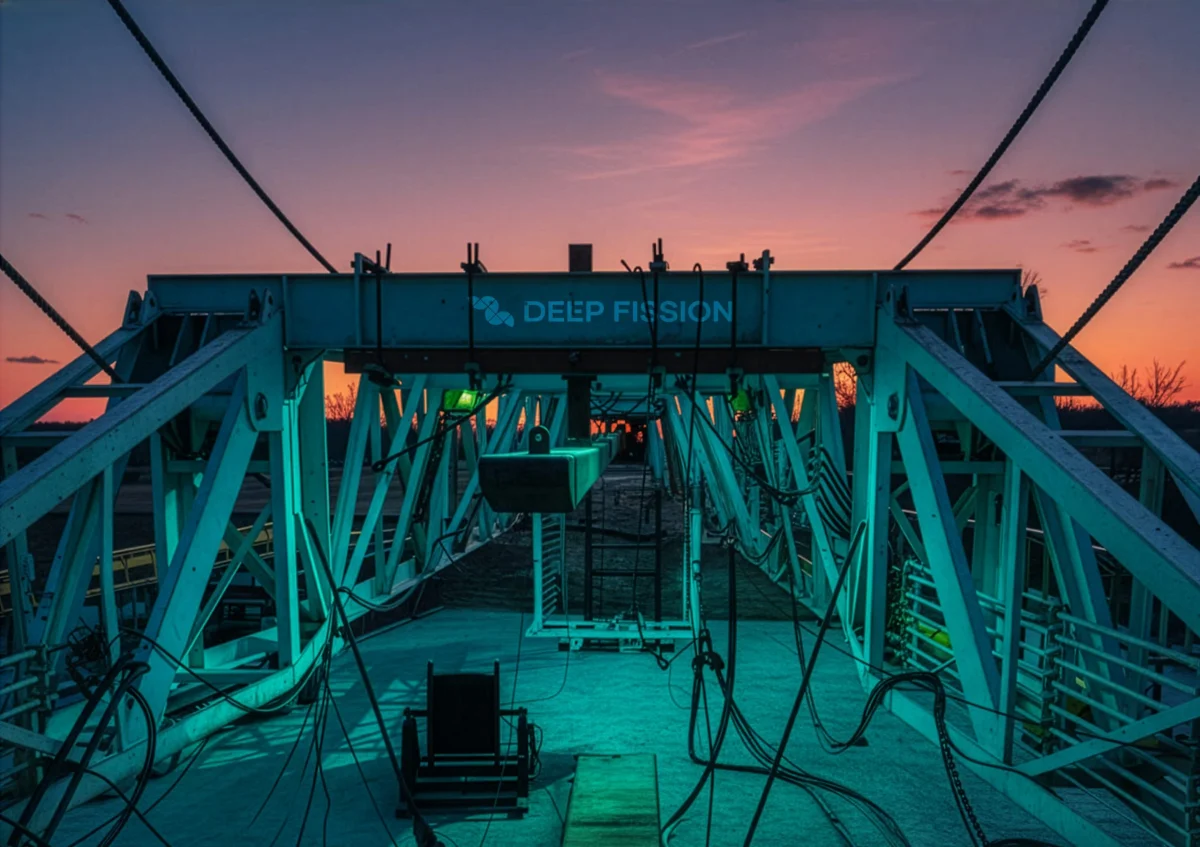
A recent announcement from Deep Fission, a nuclear energy startup, has once again placed it in the spotlight, declaring its intention to go public to fund its ambitious vision of building subterranean reactors for AI data centers. This news, however, carries a distinct echo of the past, prompting seasoned observers to recall a strikingly similar declaration from the company just a year prior. The unfolding narrative surrounding Deep Fission’s public market ambitions presents a complex picture, intertwining cutting-edge energy solutions with unconventional financial maneuvers and significant developmental hurdles.
The Unconventional IPO Saga
Last September, Deep Fission embarked on what it presented as its initial journey into the public markets. The company completed a reverse merger with Surfside Acquisition, a Delaware-based shell company, a strategy often employed by private entities to bypass the traditional IPO process and gain a public listing. This transaction was accompanied by a private placement that raised $30 million at $3 per share. At the time, Deep Fission indicated its plan to list on the OTCQB, a marketplace designed for developing companies that do not yet meet the stringent listing criteria of major exchanges like the New York Stock Exchange or Nasdaq.
Yet, despite the completion of the reverse merger and the company becoming a reporting entity with U.S. Securities and Exchange Commission (SEC) obligations, Deep Fission’s stock never actually commenced trading. Searches for the company on the OTCQB platform yielded no results, and in a more recent S-1 filing, the company explicitly stated that its stock had never been publicly traded. This effectively rendered the previous "going public" announcement public in name only, leaving investors and industry watchers with lingering questions about the true nature and intent of that initial maneuver.
Now, Deep Fission is pursuing a more conventional initial public offering (IPO) on the Nasdaq exchange, aiming to raise $157 million at a share price between $24 and $26. This new offering seeks to value the company at up to $1.66 billion, a substantial figure for an enterprise that, just a year ago, reportedly struggled to secure a $15 million funding round. The stark contrast between the previous attempt and the current, more ambitious Nasdaq listing underscores the unique and somewhat perplexing trajectory of Deep Fission’s financial strategy.
The Promise of Deep Fission: Subterranean Nuclear for AI
Deep Fission’s core mission is rooted in addressing one of the most pressing infrastructure challenges of the 21st century: the insatiable energy demands of artificial intelligence. As AI models grow in complexity and scale, the data centers required to power them are becoming increasingly energy-intensive. Traditional power grids, often reliant on fossil fuels or geographically constrained renewables, struggle to meet this burgeoning demand reliably, cleanly, and efficiently.
Deep Fission proposes an innovative solution: compact nuclear reactors housed deep underground. This concept draws on the principles of advanced nuclear technology, specifically small modular reactors (SMRs) or microreactors, which are designed to be factory-built, scalable, and deployed in diverse locations. Burying these reactors subterraneanly offers several potential advantages. From a safety perspective, it could enhance containment and protection against external threats, both natural and human-made. Environmentally, it minimizes surface footprint, an increasingly valuable commodity in densely populated or ecologically sensitive areas. Furthermore, the stable thermal environment deep underground could potentially aid in reactor cooling and waste management, though these aspects present their own set of engineering challenges.
The market impact of successfully deploying such technology could be transformative. Dedicated, localized nuclear power sources for AI data centers could provide unparalleled energy security, stability, and a dramatically reduced carbon footprint compared to conventional energy mixes. The "AI boom" has created a powerful incentive for novel energy solutions, attracting significant investment and innovation into sectors that can promise reliable, high-density power. Deep Fission aims to position itself at the nexus of these two burgeoning industries, hoping to capitalize on the urgent need for sustainable and resilient energy infrastructure for the future of artificial intelligence.
A Deep Dive into the Financials and Red Flags
Despite the ambitious vision, a closer examination of Deep Fission’s financial disclosures reveals a less optimistic outlook. The S-1 filing submitted on May 20, outlining the details of its new Nasdaq IPO, paints an arguably bleaker financial picture than its December predecessor. One of the most significant concerns is the company’s timeline for achieving criticality – the crucial point at which a nuclear chain reaction becomes self-sustaining. In December, Deep Fission had hoped to reach this milestone by July 2026; the latest filing no longer provides an estimated date, signaling a delay in a fundamental aspect of its core technology development.
Financially, the startup’s position has demonstrably worsened. As of March, its accumulated deficit had expanded to $88.1 million, a substantial increase from $56.2 million just months prior. Furthermore, in the six weeks leading up to the filing, the company’s cash and cash equivalents declined by $6.4 million, representing approximately a 7% reduction in its liquid assets.
Perhaps most concerning for potential investors is the inclusion of a "going concern" warning in the new S-1 statement, a red flag that was also present in the December filing. This warning indicates that if Deep Fission does not successfully complete its IPO, there is substantial doubt about its ability to continue as a going concern within the next 12 months, meaning it could run out of money. While the company did secure an $80 million equity investment, including $20 million from data center developer Blue Owl (which also signed a non-binding Memorandum of Understanding for future power plants), this capital injection was evidently insufficient to alleviate the fundamental liquidity concerns.
Technical Hurdles and Development Realities
Beyond the financial landscape, Deep Fission confronts significant technical challenges inherent in its groundbreaking approach. The company recently announced the commencement of drilling for its first of three test wells in March, aiming to collect data from depths of up to 6,000 feet. This initial well, however, measures only eight inches in diameter – a far cry from the dimensions required for commercial-scale subterranean reactors.
Deep Fission estimates that its commercial boreholes will need to be between 30 and 50 inches in diameter and extend approximately a mile deep. Even at the lower end of this projection, these boreholes would be considerably larger than those typically utilized in the oil and gas industry, which itself operates at the forefront of drilling technology. The complexity of drilling such wide, deep, and stable shafts, particularly in diverse geological formations, presents an immense engineering hurdle. Until Deep Fission can definitively prove its capability to excavate boreholes of the necessary scale and integrity, finalizing its reactor design, which is intimately dependent on the physical constraints of its housing, remains a formidable obstacle.
The prioritization of drilling, as highlighted by the company, could be seen as a tacit acknowledgment that the seemingly straightforward act of "making holes in the ground" is, in reality, a highly complex and capital-intensive endeavor. The delays in achieving criticality further underscore the technical complexities involved in bringing a novel nuclear reactor concept from theoretical design to operational reality.
The Broader Nuclear Renaissance Context
Deep Fission’s journey unfolds against a backdrop of renewed global interest in nuclear power. After decades of stagnation following incidents like Chernobyl (1986) and Fukushima (2011), which led to public apprehension and regulatory tightening, nuclear energy is experiencing a renaissance. This resurgence is driven by an urgent need for reliable, carbon-free energy sources to combat climate change and ensure energy security amidst geopolitical uncertainties. Governments worldwide are reinvesting in nuclear research and development, and private capital is flowing into innovative startups.
A significant part of this new wave focuses on Small Modular Reactors (SMRs) and advanced reactors, which promise enhanced safety features, greater flexibility in deployment, and potentially lower construction costs compared to traditional large-scale nuclear plants. These designs are often touted as the future of nuclear energy, capable of powering everything from remote communities to industrial complexes.
This heightened market enthusiasm for fission power likely contributes to Deep Fission’s confidence in pursuing a high-valuation IPO, despite its early developmental stage. Just last month, another nuclear fission startup, X-energy, successfully went public with an upsized IPO, demonstrating investor appetite for the sector. However, X-energy presents a stark contrast to Deep Fission. X-energy is already generating revenue and is significantly further along in the rigorous licensing process with the Nuclear Regulatory Commission (NRC), a critical and lengthy pathway for any nuclear technology developer. The NRC’s stringent oversight is designed to ensure the safety and security of nuclear facilities, and advancing through its stages is a testament to technical and operational maturity.
Analytical Commentary: Valuation Versus Progress
The comparison between Deep Fission and X-energy serves as a crucial reminder that in a sector where technological promise can often outpace practical reality, valuation and tangible progress are not always synonymous. Deep Fission’s target valuation of up to $1.66 billion appears remarkably high given its pre-revenue status, deteriorating financial health, and the significant technical and regulatory hurdles it still faces.
The motivations behind Deep Fission’s repeated and now amplified public offering attempt are subject to analytical scrutiny. It is plausible that the company and its backers are seeking to capitalize on the broader investor excitement surrounding advanced nuclear technology, particularly as it intersects with the burgeoning demand from the AI sector. The urgent need for capital, as evidenced by the "going concern" warning, also strongly suggests that the IPO is less about celebrating commercial or technical breakthroughs and more about securing essential funding to continue operations.
For investors, this situation highlights the inherent risks in highly speculative ventures, particularly those in capital-intensive, long-development-cycle industries like nuclear energy. Investing in Deep Fission at this juncture would entail a bet on the successful navigation of complex engineering challenges, the favorable evolution of a demanding regulatory landscape, and the eventual commercialization of an unproven technology, all while the company grapples with significant financial pressures. While the vision of subterranean nuclear power for AI is compelling, the path to realizing it appears fraught with uncertainty, making due diligence paramount for any prospective stakeholder.







 Azin Asro