Amir Mahmud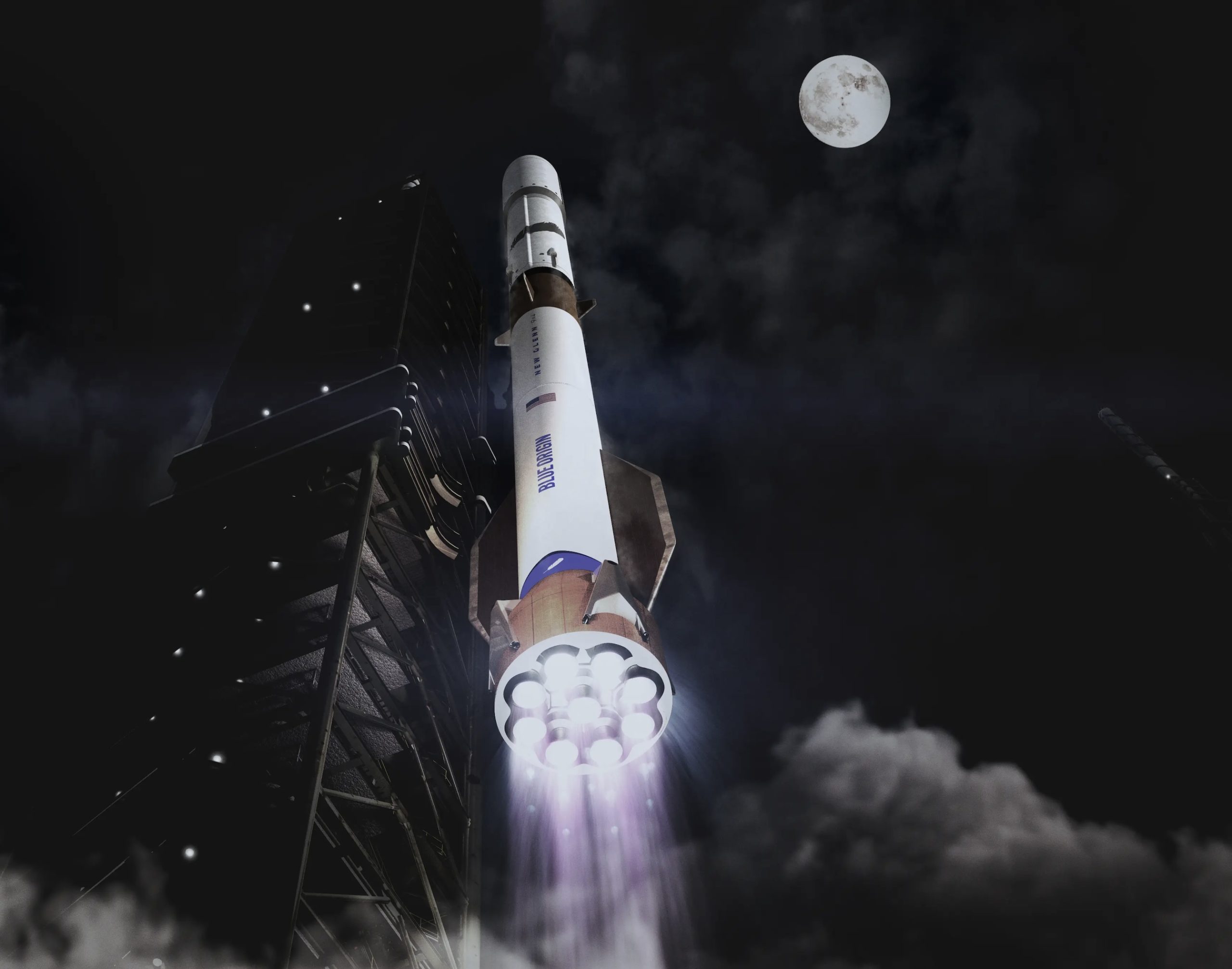
Following the successful second flight of its New Glenn mega rocket, Jeff Bezos’s space venture, Blue Origin, has unveiled ambitious plans for an even more formidable version of its heavy-lift launch system. This expanded iteration, dubbed New Glenn 9×4, significantly boosts the rocket’s capabilities, making it a towering competitor in the burgeoning commercial space industry and a potential game-changer for lunar and deep space exploration. Its immense scale rivals, and in some dimensions surpasses, historical icons like the Saturn V, positioning it directly against contemporary giants such as SpaceX’s Starship.
The Dawn of a New Era in Heavy-Lift
The newly revealed New Glenn 9×4 variant represents a substantial upgrade in thrust and payload capacity, designed to meet the escalating demands of next-generation space missions. The most striking modification involves an increase in engine count: the booster stage will now feature nine of Blue Origin’s BE-4 engines, up from the original seven, while the upper stage will employ four BE-3U engines, an increase from two. This enhanced propulsion system dramatically elevates the rocket’s performance metrics, enabling it to deliver over 70 metric tons to low-Earth orbit (LEO). This capability places it firmly in the super-heavy lift category, a domain previously dominated by government-funded programs and now increasingly pursued by private enterprises.
To put this into perspective, the legendary Saturn V, which powered the Apollo missions to the Moon, could lift approximately 118 metric tons to LEO in its most powerful configuration. While the New Glenn 9×4’s advertised capacity is slightly less than Starship’s current theoretical 100 metric tons, Blue Origin’s design philosophy emphasizes reusability and a robust operational cadence, aiming for long-term cost efficiency and reliability. The sheer physical presence of this new variant is also noteworthy; at its full height, it will stand taller than the Saturn V, a testament to the scale of modern private space endeavors. The company intends for this super-heavy variant to operate concurrently with the existing New Glenn 7×2 model, offering customers a flexible range of launch services.
A Competitive Landscape
The unveiling of the New Glenn 9×4 intensifies the ongoing "space race" among commercial entities, particularly between Blue Origin and SpaceX. For years, SpaceX’s Starship has captured headlines with its ambitious designs for full reusability and unprecedented payload capacity, aiming for human missions to Mars. Blue Origin’s New Glenn, while having a longer development timeline than initially projected, now presents a formidable alternative, signaling a robust and competitive market for heavy-lift services. This competition is crucial for innovation, potentially driving down launch costs, increasing access to space, and accelerating technological advancements.
Beyond SpaceX, other players like United Launch Alliance (ULA) with its Vulcan Centaur and government agencies with systems like NASA’s Space Launch System (SLS) also occupy segments of the heavy-lift market. However, New Glenn and Starship distinguish themselves with their emphasis on reusability, a paradigm shift initiated by SpaceX’s Falcon 9 that promises to transform space transportation economics. The ability to reuse expensive rocket components, particularly the first stage, can drastically reduce per-launch costs, making space more accessible for a wider array of commercial and scientific missions. This fierce competition ultimately benefits governments, research institutions, and private companies seeking to deploy satellites, explore celestial bodies, or establish new space-based industries.
Enabling Ambitious Missions
The expanded capabilities of the New Glenn 9×4 are strategically designed to address several high-priority segments of the burgeoning space economy. Its substantial payload capacity and larger fairing – the protective shell enclosing the cargo – will open doors for missions that were previously impractical or prohibitively expensive.
One primary target is the deployment of mega-constellations. Companies like Amazon (with its Project Kuiper, a direct competitor to SpaceX’s Starlink), OneWeb, and others are planning to launch thousands of satellites into LEO to provide global broadband internet access. These constellations require frequent, high-volume launches, making a super-heavy, reusable rocket an ideal solution for efficient and cost-effective deployment. Blue Origin’s parent company, Amazon, is a key customer for Project Kuiper, providing a built-in demand for New Glenn’s services.
Furthermore, the New Glenn 9×4 is poised to play a critical role in lunar and deep space exploration. NASA’s Artemis program aims to return humans to the Moon, establish a sustainable presence, and prepare for eventual missions to Mars. This initiative relies heavily on commercial partners for various aspects, including cargo delivery, landers, and habitat components. Blue Origin is already competing for NASA contracts related to lunar landers with its Blue Moon program. The enhanced New Glenn can transport larger scientific instruments, lunar habitats, and critical supplies, supporting both robotic and human missions beyond Earth orbit. The company’s recently released rendering of the New Glenn 9×4, prominently featuring the Moon in the background, clearly teases its lunar ambitions.
Finally, the rocket is also being positioned for national security imperatives, including projects like "Golden Dome." While specifics of such programs are often classified, they generally involve deploying sophisticated reconnaissance, communication, or defensive assets into various orbits. The ability to launch large, complex payloads rapidly and reliably is paramount for national defense and intelligence operations, underscoring the strategic importance of Blue Origin’s advancements.
Blue Origin’s Trajectory and Vision
Blue Origin, founded by Amazon CEO Jeff Bezos in 2000, operates with a long-term vision encapsulated in its motto, "Gradatim Ferociter" (Step by Step, Ferociously). Bezos’s ultimate goal is to enable millions of people to live and work in space, preserving Earth for future generations. The company began its journey with the suborbital New Shepard rocket, which has successfully flown numerous tourist and research missions to the edge of space and back, proving key reusability technologies.
New Glenn represents the company’s leap into orbital spaceflight, designed from the outset as a reusable heavy-lift vehicle. Its development has been a multi-year endeavor, characterized by methodical engineering and significant capital investment. The commitment to developing powerful engines like the BE-4, which also powers ULA’s Vulcan Centaur, highlights Blue Origin’s foundational approach to building core space infrastructure. This steady, if sometimes slow, progression reflects a strategy of meticulous development, aiming for robust and reliable systems rather than rapid deployment at all costs. The recent successful second flight of the standard New Glenn 7×2 variant was a crucial milestone, demonstrating the system’s operational viability and paving the way for these ambitious upgrades.
Evolution of the New Glenn Platform
Even the original New Glenn 7×2 configuration is undergoing significant enhancements, demonstrating Blue Origin’s commitment to continuous improvement across its entire launch platform. Recent updates to this standard variant include an increase in its total thrust, further boosting its capacity and performance envelope for a wider range of missions.
Perhaps most notably, the 7×2 version will now feature reusable fairings. This is a significant development for reducing launch costs. Historically, fairings were expendable components, burning up in the atmosphere or splashing down unrecovered after payload deployment. By making them reusable, Blue Origin aims to retrieve, refurbish, and relaunch these expensive components, contributing to the overall economic efficiency of the New Glenn system. This mirrors similar efforts by competitors to recover fairings, further solidifying reusability as a fundamental driver of the modern space economy.
Beyond these major changes, Blue Origin has also implemented other smaller, yet crucial, upgrades aimed at reducing the turnaround time between launches. In the highly competitive commercial launch market, the ability to launch frequently and reliably is as important as raw payload capacity. Faster turnaround times translate into increased launch cadence, allowing Blue Origin to serve more customers and deploy payloads more efficiently, which is particularly vital for the aforementioned mega-constellations. These iterative improvements underscore a comprehensive strategy to optimize the New Glenn platform for both performance and operational efficiency.
The Lunar Imperative
Blue Origin’s aspirations for lunar exploration are deeply intertwined with the enhanced New Glenn. The company is actively developing its Blue Moon Mark 1 lunar lander, an uncrewed vehicle designed to deliver cargo to the lunar surface. The larger New Glenn 9×4 provides the necessary heavy-lift capacity to transport not only the Blue Moon lander but also potentially larger, more complex lunar payloads, including components for future human habitats or advanced scientific observatories.
NASA’s Artemis program represents a generational opportunity for private companies to contribute significantly to human spaceflight beyond LEO. Blue Origin, alongside other commercial partners, is vying for contracts to develop and operate lunar landers, cargo delivery systems, and other infrastructure critical for a sustained human presence on the Moon. The visual representation of the New Glenn 9×4 with a prominent Moon in its illustration is a clear signal of Blue Origin’s intent to be a central player in this new era of lunar exploration. The ability to launch the Blue Moon Mark 1 lander using its own integrated launch system would provide Blue Origin with end-to-end lunar mission capability, a significant advantage in the competitive landscape.
Challenges and Horizons
While the announcement of the New Glenn 9×4 is a significant milestone, Blue Origin still faces the considerable challenges inherent in developing and operating super-heavy launch vehicles. These include the complexities of manufacturing at scale, rigorous testing and qualification processes, ensuring high reliability, and ultimately securing a substantial market share against entrenched and rapidly innovating competitors. The aerospace industry is known for its long development cycles and high capital requirements, demanding sustained investment and technical excellence.
However, the horizons are vast. The enhanced New Glenn, with its immense power and reusability features, has the potential to unlock new frontiers in space. It could facilitate the construction of large space stations, support asteroid mining operations, enable advanced scientific missions to the outer solar system, and ultimately contribute to the realization of Jeff Bezos’s long-term vision of humanity’s expansion into space. The increased competition in the heavy-lift sector promises to make space access more routine and affordable, driving a new wave of exploration, innovation, and economic activity beyond Earth.
Looking Ahead: The Next Steps
With the second flight of the New Glenn 7×2 now successfully completed, Blue Origin is focused on its next operational milestones. While a specific date for the next launch has not been formally announced, it is currently anticipated for early 2026. This mission could potentially see Blue Origin attempt to launch and land its uncrewed Blue Moon Mark 1 lunar lander, a critical step toward validating its lunar capabilities. The successful deployment and operation of the Blue Moon lander would be a pivotal demonstration of Blue Origin’s deep space prowess, further solidifying its position as a major contender in the global space industry and paving the way for the colossal ambitions embodied by the New Glenn 9×4.