Amir Mahmud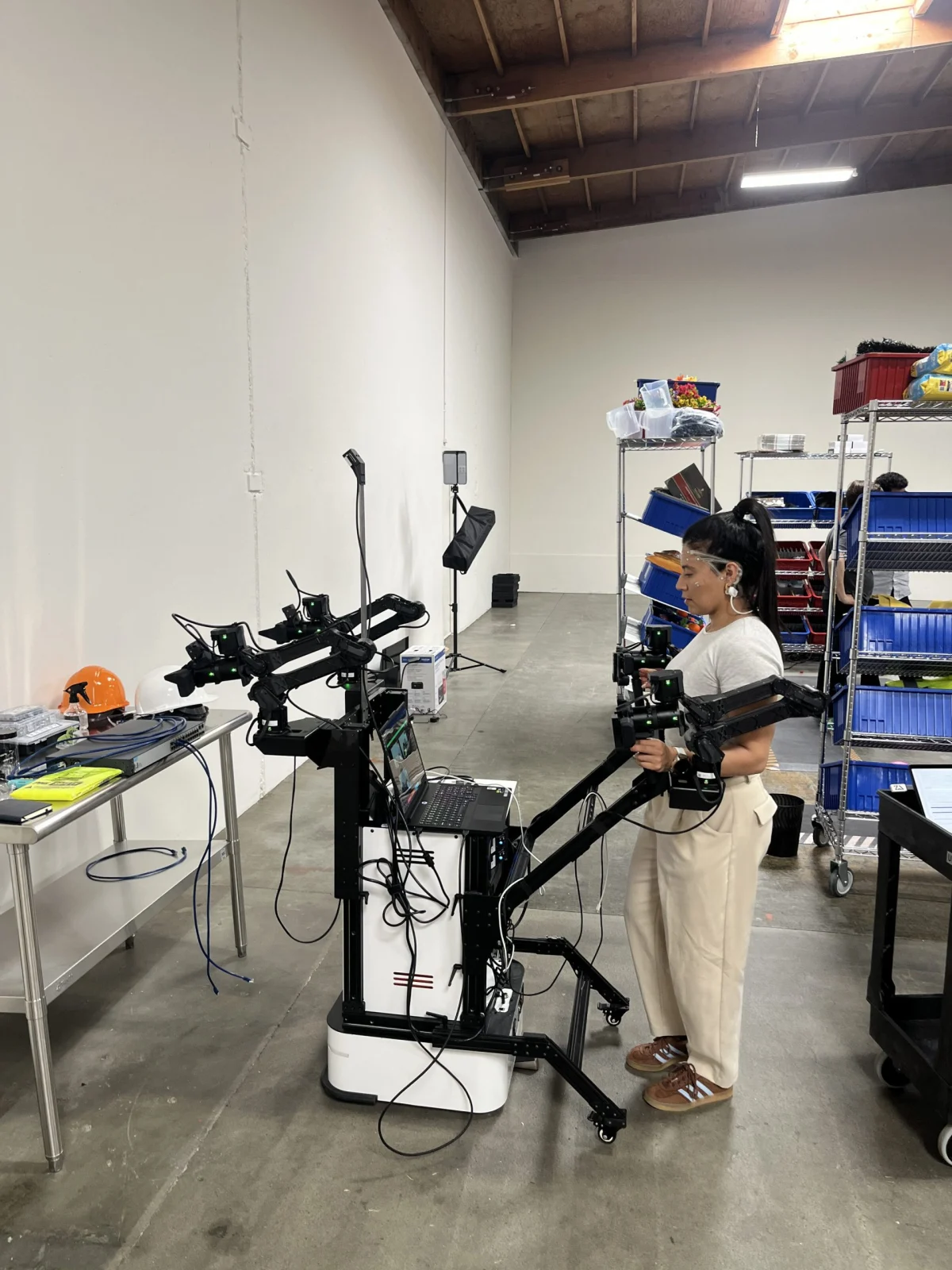
In a nondescript warehouse in San Leandro, California, a seemingly simple game of Jenga is unfolding, yet its implications resonate far beyond mere leisure. Here, at the operational heart of Encord, a company specializing in data tooling for artificial intelligence, human "pilots" are meticulously performing tasks that could fundamentally redefine the capabilities of future robotics. One such pilot, Andrew Ceja, carefully extracts wooden blocks from a precarious tower, his every move meticulously recorded. What distinguishes this scene from typical robot training data collection is the sophisticated headset he wears: equipped not only with a camera tracking his gaze but also with sensors designed to capture his brain waves. This pioneering effort represents a critical, "bleeding edge" endeavor to bridge the vast chasm between the intellectual prowess of modern AI and the nuanced dexterity required for physical interaction with the real world.
The Unseen Bottleneck: Data Scarcity in Physical AI
The landscape of artificial intelligence has been dramatically reshaped by the advent of Large Language Models (LLMs), which have demonstrated astonishing capabilities in understanding and generating human text. Their success is largely predicated on access to colossal datasets—the entirety of the internet’s textual corpus and beyond. However, the path to achieving similar breakthroughs in physical AI, particularly in humanoid and warehouse robotics, has encountered a formidable obstacle: the acute scarcity of real-world physical training data. Unlike the digital realm where information is abundant and easily scraped, teaching robots to perceive, manipulate, and interact with the physical environment demands data that is complex, multi-modal, and often costly to acquire.
Robotics companies have long grappled with this data dilemma. Traditional methods involve arduous manual programming or highly controlled simulations, both of which struggle to capture the infinite variability and unpredictability of real-world scenarios. While self-driving car companies invest heavily in collecting their own vast troves of sensory data, scaling such an operation for general-purpose robotic manipulation across diverse environments proves exponentially more challenging. Training from video footage, though increasingly sophisticated, often lacks the granular fidelity and contextual depth necessary for a robot to truly understand the nuances of a physical task. Vineeth Velmurugan, Encord’s head of robot learning and a veteran of OpenAI’s robot lab and warehouse automation firm Berkshire Grey, estimates that breaking through this bottleneck might necessitate a dataset five times the size of YouTube’s entire video corpus—a staggering scale that underscores why data generation itself is evolving from a research problem into a specialized business imperative.
Encord’s Evolution: From Data Management to Data Manufacturing
Encord was initially established to provide robust solutions for annotating data and evaluating models for companies developing machine-vision applications. However, as their client base—comprising many leading robotics firms whose names remain undisclosed due to confidentiality agreements—began to push the boundaries of end-to-end learning for complex robotic manipulation tasks, a stark reality emerged. Executives at Encord realized that merely managing existing data was insufficient; the profound lack of suitable physical training data necessitated a more proactive approach. "The data simply does not exist," Velmurugan succinctly states, encapsulating the core challenge.
This recognition catalyzed a significant strategic pivot for Encord. Rather than solely offering tools to organize and refine data that clients already possessed, the company embarked on a new mission: to actively manufacture the specialized data that robotics companies desperately needed. This shift reflects a broader industry trend where the generation of high-quality, task-specific datasets is becoming as critical as the development of advanced model architectures. Encord’s San Leandro facility now serves as a dynamic laboratory for experimenting with novel data collection modalities and meticulously crafting datasets for specific skills, fine-tuning the foundational intelligence that will power the next generation of autonomous systems.
Brain Waves: A Deep Dive into Human Intent and Error
At the forefront of Encord’s experimental data collection efforts is its collaboration with Zander Labs, a German neuroscience startup. Zander Labs is pioneering the use of brain activity measurement to deduce human mental states—such as error, intent, and surprise—during complex physical tasks. The hypothesis is compelling: by correlating specific brainwave patterns with corresponding physical actions and their outcomes, a more insightful and actionable dataset can be created to train AI models. For instance, detecting a surge in neural activity indicative of "error" when a human pilot makes a mistake could provide a robot with invaluable feedback, teaching it not just the correct action but also identifying potential pitfalls and how to avoid them. Similarly, understanding the "intent" behind a human’s preparatory movements could enable a robot to anticipate actions, leading to more fluid and collaborative human-robot interactions.
Lucas Gehrke, a neuroscientist supervising the work at Zander Labs, highlights that the varying levels of brain activity during a task offer crucial clues for model builders. This information can help determine when to deploy the highest-effort, most computationally intensive models, optimizing resource allocation and improving efficiency. The current work between Encord and Zander Labs is a trial run, focused on building an initial brain wave-tagged dataset. The ultimate goal is to rigorously evaluate whether incorporating this unique modality genuinely improves the performance of customer robotics models before considering a broader scale implementation. While the integration of brain-computer interfaces (BCIs) in robotics has historical precedents in direct control or prosthetic applications, this approach of leveraging neuro-cognitive signals for training data represents a novel frontier, aiming to imbue robots with a deeper, human-like understanding of task execution beyond mere visual or kinematic observation.
A Spectrum of Innovative Data Collection Methodologies
Encord’s San Leandro facility showcases a diverse array of data collection strategies, each designed to capture different facets of human interaction with the physical world. One primary source is "egocentric" video, collected by workers wearing cameras that provide a first-person perspective, often augmented with additional camera angles and other metrics. This method offers a rich, immersive view of tasks as they are performed, crucial for understanding human perception and interaction from a subject’s point of view.
Beyond egocentric data, the facility houses various specialized rigs. Pilots operate "leader-follower" systems, comprising paired robotic arms where one is directly controlled by a human operator while the other mimics its movements. This setup is instrumental in generating precise data for delicate manipulation tasks, such as pouring coffee from a pot into mugs (a surprisingly challenging task due to liquid dynamics) or carefully stacking poker chips. These are precisely the types of nuanced actions that humanoid robot developers frequently request, indicating a strong market demand for such specific manipulation datasets. The warehouse is filled with an eclectic inventory of training props: cartons of artificial flowers, books, plastic vegetables, kitty litter trays and scoops, and bundles of wires—all commonplace objects used to train manipulators for a wide range of household and industrial tasks.
Another pilot, Sofia Infante, demonstrates the complexity of fine manipulation by maneuvering robotic arms to plug and unplug ethernet cables from the back of a server rack. This task, critical for data center automation, highlights the current limitations of robotic dexterity. Observing the process reveals why such precision remains elusive: robotic grippers often lack the multiple degrees of freedom and tactile sensitivity inherent in human fingers, making tasks requiring intricate force feedback and precise alignment exceedingly difficult for machines. In a further innovation, Encord is also developing a new data modality that uses sensors strapped to the forearm to detect electrical signals in muscles. The objective here is to overcome the limitations of video, which often fails to capture the entire hand during manipulation. By building a 3D depiction of hand position and movement based on muscle activity, Velmurugan hopes to create a more robust and comprehensive understanding for AI models, leading to greater dexterity and adaptability.
The Economics of Embodied AI Training Data
The cost disparity between training Large Language Models and physical AI models is a critical factor shaping the industry. While LLMs benefited from the virtually free and boundless text data available across the internet, generating physical training data is an inherently expensive undertaking. It requires specialized hardware, dedicated facilities, and a skilled human workforce to perform tasks, often repeatedly and under varying conditions. This fundamental economic difference places a significant constraint on the development and deployment of advanced robotics.
To mitigate this cost and maximize data utility, Encord places a premium on highly detailed annotation. Their datasets are meticulously tagged with precise physical descriptions, such as "right hand tightens bolt," aiding LLM-based models in comprehending the exact actions and intentions within a video sequence. Velmurugan estimates that this dense, descriptive annotation is roughly 100 times more valuable than generic "ego data" for training specific tasks. While it costs approximately 20 times more to produce, this trade-off is considered favorable on paper due to the exponential increase in data quality and actionable insights. This higher cost, however, fundamentally alters the economic model for building these advanced AI systems. Unlike the low-cost data acquisition for LLMs, physical AI necessitates a "manufacturing" approach, where data is intentionally created and refined, rather than merely collected.
Strategic Advantage and the Future Outlook
Encord’s unique position, situated as an intermediary serving numerous robotics companies across the industry, provides it with an invaluable vantage point. This allows the company to observe and analyze which data techniques and modalities are gaining traction and proving effective, offering insights that individual customers might not readily access. This strategic advantage enables Encord to refine its data generation methodologies continuously, staying at the forefront of the evolving needs of physical AI development.
The burgeoning workforce of "pilots" at Encord’s facility, including individuals like Andrew Ceja and Sofia Infante who previously worked at other AI data annotation firms, represents a new frontier in human-AI collaboration. Their role is not simply to execute tasks but to provide the nuanced, human-centric data that enables robots to learn and adapt. For Ceja, who once maintained a robotic trash sorter, the transition to training robots for intricate tasks like Jenga is a welcome challenge. "It’s something new every day!" he exclaims, highlighting the dynamic and evolving nature of this work.
The success of these efforts has profound implications for a multitude of industries. More capable and adaptable robots could revolutionize warehousing and logistics, enhance manufacturing precision, assist in healthcare, and even integrate into daily household tasks, potentially freeing human workers from dangerous, repetitive, or strenuous labor. As the demand for intelligent physical systems continues to surge, the meticulous, human-driven generation of high-quality training data, increasingly augmented by cutting-edge neuro-cognitive insights, will remain an indispensable cornerstone in the quest to build truly autonomous and dextrous robots. The journey from a Jenga game in San Leandro to a future populated by highly intelligent physical AI is a testament to the innovative spirit driving the next era of artificial intelligence.