Amir Mahmud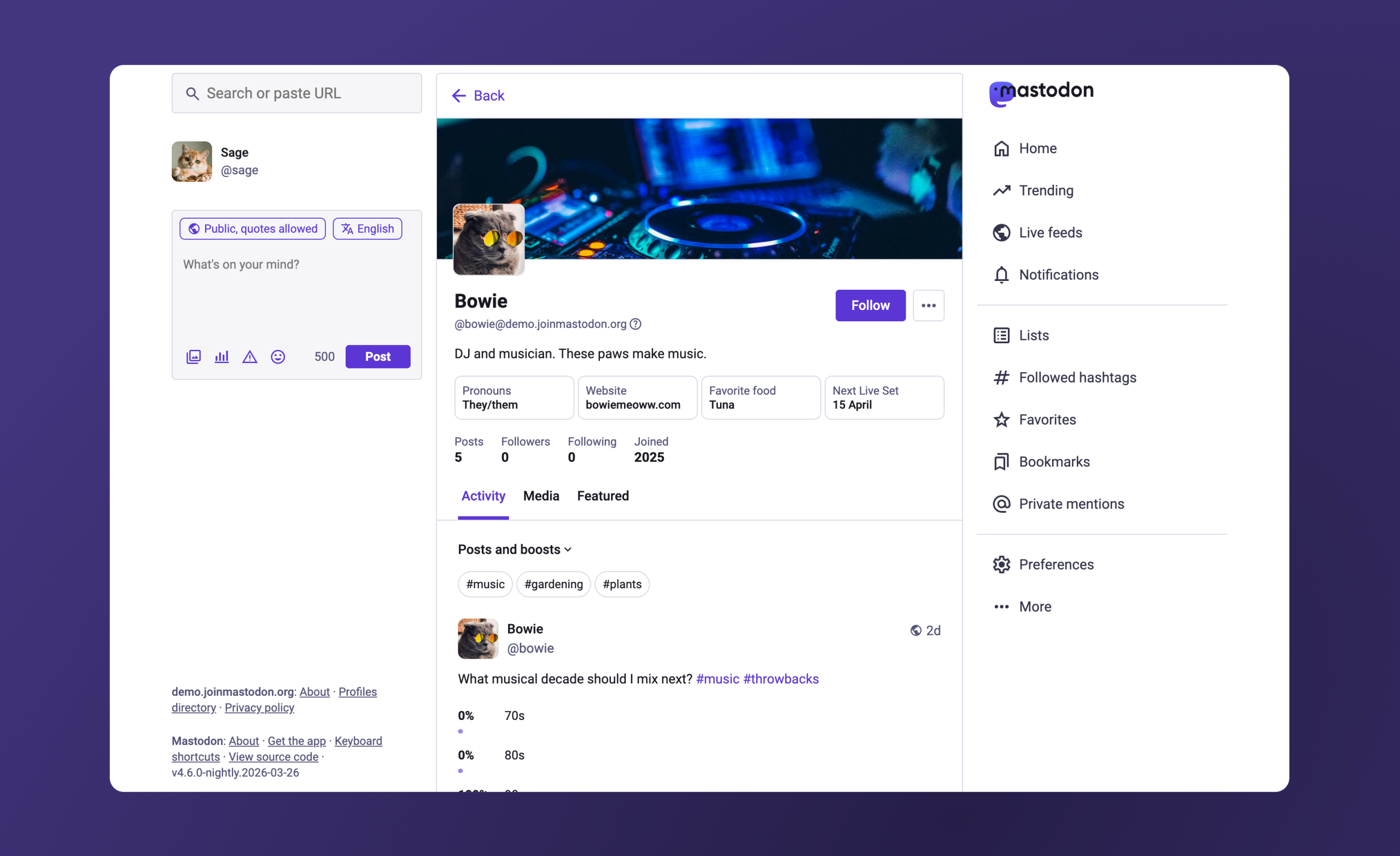
The decentralized social networking platform Mastodon has announced a significant overhaul of its user profiles, marking a crucial step in its ongoing mission to enhance accessibility and attract a broader audience. This strategic redesign, revealed by the open-source software maker, aims to make the platform more intuitive and appealing, particularly for mainstream users and organizations seeking alternatives to dominant centralized services like X (formerly Twitter) or Meta’s Threads.
The Genesis of Decentralized Social Media
Mastodon’s journey began in 2016, founded by Eugen Rochko, with a vision to create a social network that prioritized user control and community autonomy over corporate interests. It operates on the ActivityPub protocol, an open, decentralized social networking protocol that allows different servers (known as "instances") to communicate and share content, forming a vast, interconnected network called the "Fediverse." Unlike traditional social media platforms, where a single company controls all data, algorithms, and moderation policies, Mastodon distributes these responsibilities across thousands of independent instances. This architecture means no single entity dictates what users see, who they can follow, or how their data is handled. Users can choose an instance that aligns with their values and interests, and crucially, they retain the ability to migrate their accounts and data if they become dissatisfied with their chosen server’s operation or moderation.
The platform gained considerable prominence in late 2022 following Elon Musk’s acquisition of Twitter. Amid widespread user discontent over policy changes, content moderation shifts, and concerns about the platform’s future direction, many individuals and organizations began actively seeking alternatives. Mastodon, with its anti-corporate ethos and decentralized structure, emerged as a leading destination for this "Twitter exodus." Its monthly active user count surged, reaching over one million at the peak of the migration, demonstrating a palpable demand for social media experiences outside the control of tech giants.
The Double-Edged Sword of Decentralization
While Mastodon’s decentralized nature is its foundational strength and primary appeal, it has also presented its most significant barrier to widespread adoption. The very features that distinguish it – the necessity to choose a server, the existence of local and federated timelines, and a more complex process for following users across instances – can be bewildering for newcomers accustomed to the seamless, centralized sign-up processes of platforms like Facebook, Instagram, or X. The concept of a Mastodon handle, which includes both a username and the instance domain (e.g., @username@server.social), often requires an explanation that traditional platforms simply don’t.
This inherent complexity has hindered Mastodon’s ability to retain the surge of users it acquired during the Twitter transition. After reaching its peak, the platform’s monthly active users stabilized, hovering around 800,000, indicating a challenge in converting curious new users into long-term community members. Many found the initial learning curve too steep or the decentralized interface less intuitive than what they were used to.
A Strategic Evolution Towards User Friendliness
Recognizing these hurdles, the Mastodon development team has embarked on a concerted effort to streamline the user experience without compromising its core decentralized principles. This strategic evolution represents a mature phase for the platform, moving beyond its initial appeal to tech-savvy early adopters and aiming for a more universally accessible design.
Earlier in the year, these efforts manifested in several key updates. February saw a simplification of the onboarding process, making it easier for new users to understand the federated model and find a suitable instance. Crucially, Mastodon also introduced features that users expected from mainstream platforms, such as "Quote Posts" (its version of a retweet with commentary), and "Collections," which function as "starter packs" to help users discover relevant content and communities more easily. These incremental improvements signaled a clear intent to bridge the gap between its unique architecture and the usability expectations of a broader audience.
The Comprehensive Profile Redesign: A Deep Dive
The latest set of updates, specifically targeting user profiles, builds on this momentum by addressing critical visual and functional pain points. The changes are designed to make profiles more informative, customizable, and less cluttered, catering to both individual users and professional entities.
One of the most significant changes is the consolidation of post views. Previously, profiles often presented separate tabs for a user’s "posts" and "posts and replies." The revamped design introduces a single, unified "Activity" tab. Within this tab, a new dropdown menu empowers users to configure various combinations of content, allowing them to easily toggle on or off replies and "boosts" (Mastodon’s equivalent of a repost). This simplification removes redundancy and offers greater control over how a user’s content stream is displayed.
Further enhancing content discoverability, hashtags associated with an account now prominently appear at the top of the "Activity" tab. This intuitive placement allows visitors to quickly filter the posts on that account by clicking on a specific tag, making it easier to navigate a user’s thematic content without endless scrolling.
A feature that had drawn criticism from some users, the "pinned posts carousel," has been retired. This carousel, intended to balance the display of multiple pinned posts with access to recent activity, was often perceived as clunky. In its place, Mastodon now features one prominent pinned post, with a clear "View all pinned posts" button to reveal any additional pinned content. This approach ensures that important information remains visible while maintaining a cleaner, more streamlined profile layout.
Addressing the unique nature of Mastodon handles, a new informational pop-up has been integrated. This feature is specifically designed to clarify the "@username@server" format for newcomers, explaining that the two "at" symbols refer to both the account name and the server’s name. This small but vital addition aims to demystify one of the more confusing aspects of the federated system for new users.
Users also gain enhanced control over the visual presentation of their profiles. New options allow individuals to hide the "Media" or "Featured" tabs if desired, or even hide replies from their "Media" tab. This level of customization is particularly beneficial for artists, photographers, or professionals who wish to showcase their original work without replies intermingling.
Custom fields on profiles, where users typically add important information like links, pronouns, or other relevant details, now appear side-by-side, optimizing vertical screen space. Crucially, these fields are now editable directly from iOS and Android devices, a significant improvement from the previous web-only editing restriction. Other subtle but impactful design tweaks include the removal of the "following you" badge for a less cluttered look and the relocation of the optional "personal note" to an overflow menu.
For comprehensive profile management, Mastodon has centralized all editing functions into one intuitive location within account settings. This unified interface simplifies tasks such as managing featured hashtags (with helpful suggestions now provided by the platform), links, and other profile information. Furthermore, link verification – Mastodon’s method for establishing credibility without relying on a centralized authority or requiring payment – has been made more accessible, no longer buried deep within settings. Finally, users can now crop and add alternative text to their profile images and cover photos, improving both aesthetic control and accessibility.
Market Impact and Future Trajectory
These profile enhancements will initially roll out to the mastodon.social server and other instances that opt to run the nightly build, with wider availability expected when the Mastodon 4.6 software update is released in the coming weeks.
The ongoing efforts to refine Mastodon’s user experience are crucial for its long-term viability in a competitive and rapidly evolving social media landscape. The concept of "enshittification," where platforms gradually degrade user experience to extract more value, has driven many users to seek alternatives. Mastodon, by proactively addressing its usability challenges, positions itself as a principled alternative that prioritizes user experience and control.
However, it faces formidable competition. X, despite its controversies, remains a dominant force for real-time information and public discourse. Meta’s Threads, while also built on ActivityPub, represents a centralized corporate entity attempting to leverage the protocol, posing questions about the true spirit of decentralization. Other decentralized challengers, like Bluesky with its AT Protocol, further diversify the landscape.
Mastodon’s historical appeal has largely been to tech enthusiasts, journalists, academics, and those deeply concerned with privacy and digital sovereignty. The current redesign, coupled with earlier improvements, signals a clear intent to move beyond this niche. By simplifying its interface and making profile management more intuitive, Mastodon hopes to attract and retain a broader demographic, including creatives, small businesses, and community organizations, as indicated by its focus on making profiles appealing to organizations.
The success of these updates will ultimately depend on whether they sufficiently reduce the friction for new users and provide a compelling enough experience to keep them engaged. The inherent trade-off between the ideological purity of decentralization and the practical demands of mainstream usability remains a delicate balance. Mastodon’s continued investment in user-centric design suggests a recognition that the future of decentralized social media hinges not just on its underlying philosophy, but on its ability to offer a welcoming and functional home for a diverse global audience. As the digital world increasingly grapples with questions of platform ownership, data control, and content moderation, Mastodon’s evolution will be closely watched as a bellwether for the broader movement towards a more federated internet.